Go deeper.
Try 1/7, then 1/20 and 1/100. These select the radius levels at z = 7, 20 and 100. Turn on Close-up to keep the shrinking section legible. Compare L / W with the limiting value.
Supplement · Geometry, harmonics & cycles
A slope enters a curve. An oval emerges. A question of proportion opens onto a larger question: how does nature gather, transform, and return?
An interactive study by Ryan Nagy
Inspired by the work of Walter Schauberger
01 · Walter’s question
Viktor Schauberger followed water through forests, springs and vortices. His son Walter pursued the mathematical relationships that might give those observations a language of form.
Walter Schauberger (1914–1994) was an engineer who developed his father’s ideas through models, experiments and harmonic studies. The Schauberger archive records his work with hyperbolic forms and a “Sounding Tower”: plane sections through a hyperbolic cone yielding egg-like curves. His Pythagoras Kepler School connected this research with number and musical proportion.
PKS · Walter Schauberger’s biography ↗This exhibition began with a pyramid–funnel graphic Ryan Nagy remembers encountering in connection with Walter’s work. Here, that visual intuition becomes an instrument the reader can manipulate: a defined surface, a movable plane, and a ratio that can be checked.
Its place in the Codex is as a supplemental study, linking the language of water and vortex to geometry, harmonic relationships and architectural imagination.
02 · The interactive instrument
The highlighted pyramid face carries the cutting plane. Slide it down the narrowing funnel, rotate the view, and watch the section beside it change. All dimensions are in abstract model units.
Read the right-hand panel: it shows the actual cut face-on, at equal scale in both directions. The dashed golden ellipse is a comparison. The pyramid is a movable geometric guide; this scene does not reconstruct the monument’s physical position or interior.
Open the interactive on its own ↗Try 1/7, then 1/20 and 1/100. These select the radius levels at z = 7, 20 and 100. Turn on Close-up to keep the shrinking section legible. Compare L / W with the limiting value.
Select Cylinder comparison. Its oblique cut is an exact ellipse. Unlock the angle, expand Ratio calculations & comparisons, then choose Exact golden cylinder.
Return to Reciprocal funnel and lock 51.83°. Move the position near 2.26, then slightly above and below it. Watch the closed component appear or disappear. The displayed rim also clips parts of the full curve.
03 · A golden horizon
The funnel is made by rotating the reciprocal curve around its axis. At successive whole-number depths, the radius follows 1, ½, ⅓, ¼… The same rule governs every level.
In this normalized model, r = 1/z, with z > 0. The radius approaches zero as depth increases; it never reaches zero at a finite depth. “Hyperbolic” describes the generating curve. It does not make this surface a model of hyperbolic spacetime.
At 51.83°, the finite closed section is a slightly asymmetric oval. Far down the neck, the funnel changes very little across the small cut, so its normalized proportions approach those of an inclined cylinder section.
For an oblique cut through a circular cylinder, the ellipse’s long-to-short-axis ratio is 1/cos θ. That is also the reciprocal funnel’s infinite-depth limit at a fixed angle.
The golden ratio is φ = 1.618033989…. The ideal angle whose limiting ratio equals φ is 51.827292…°. The proximity invites attention; the small numerical difference remains part of the result.
| Construction | What the section does | Relation to φ |
|---|---|---|
| Funnel · 51.83° | Finite oval; increasingly ellipse-like at depth | Limit ≈ 1.618131, slightly above φ |
| Funnel · ideal angle | Finite oval at 51.827292…° | Approaches φ as depth tends to infinity |
| Cylinder · ideal angle | Exact ellipse | Axis ratio equals φ at every complete cut |
The 51.83° setting is the exhibit’s rounded pyramid-inspired face angle, measured from the horizontal. It is a modeling convention, not a claim that every surviving casing stone has that exact inclination or that this relationship establishes the builders’ intention.
The cutting plane is z = h + x tan θ, where h is its crossing of the funnel axis. Within the plane, use equal-length coordinates u and v: x = u cos θ, y = v and z = h + u sin θ. Substitution into the surface equation gives:
This is generally a fourth-degree curve, rather than a conic ellipse. The interactive measures the closed oval when present and fully within the display. A finite pyramid face illustrates the plane; an additional branch may lie on the plane’s extension.
04 · Thresholds, harmonics & imagined passages
Small changes of position can alter the connectivity of an intersection. This is a precise geometric way into the larger idea of a transition: a loop comes into being when a threshold is crossed.
Below the threshold
The ideal intersection has no separate closed oval.
At the threshold
The plane is tangent at the point where branches meet.
Above the threshold
An oval separates from the open branch. Diagrams are schematic.
For this ideal surface and a positive angle, the critical condition is h² = 4 tan θ; at 51.83°, h ≈ 2.255787. This changes the topology of the intersection curve. The funnel itself retains the same connectivity. A topology change in a section and a change in the topology of space are different mathematical questions.
Harmonics · A useful correspondence
A harmonic series of frequencies runs f₀, 2f₀, 3f₀… Its corresponding periods run T₀, T₀/2, T₀/3… The funnel’s reciprocal radii offer a spatial analogy to that sequence of periods.
Actual resonance needs a medium, a restoring mechanism, boundaries and a source of excitation. A chamber’s shape can help select modes, but its proportions alone do not establish which modes are driven or how much energy they carry. This is where a geometric comparison can become a testable acoustic or fluid experiment.
OpenStax · Standing waves & resonance ↗Wormholes · A visual analogy
The narrowing funnel evokes the familiar image of a throat joining larger regions. Einstein and Rosen’s 1935 paper introduced a bridge between two mathematical sheets in a relativistic construction. That belongs to spacetime geometry, with its own field equations and physical conditions.
The reciprocal surface shown here has one narrowing end and no finite throat connecting two mouths. It is not a wormhole solution. Its value in this exhibition is as an analogy for concentration, passage and emergence—a prompt for inquiry, not evidence of a portal or a spacetime mechanism at Giza.
Einstein & Rosen · The original paper ↗05 · The idea of return
In the Codex, the vortex is a way of attending to relationship: inward and outward, concentration and dispersal, the part and the larger circulation that sustains it.
Water circulates through changing states and places. Oscillators return through phases. Earth’s rotation and orbit give life recurring rhythms. These processes invite a cyclical reading of nature, while each has its own causes, timescale and losses.
A cycle can repeat its pattern without restoring every detail. A watershed changes; a resonator dissipates energy; living systems carry history forward. Return and irreversible change coexist.
Here, the pyramid is approached as a meeting place for those questions. Could form organize periodic processes? Could architecture register or couple cycles of ground, water and sky? What measurements would distinguish a meaningful relationship from an attractive resemblance?
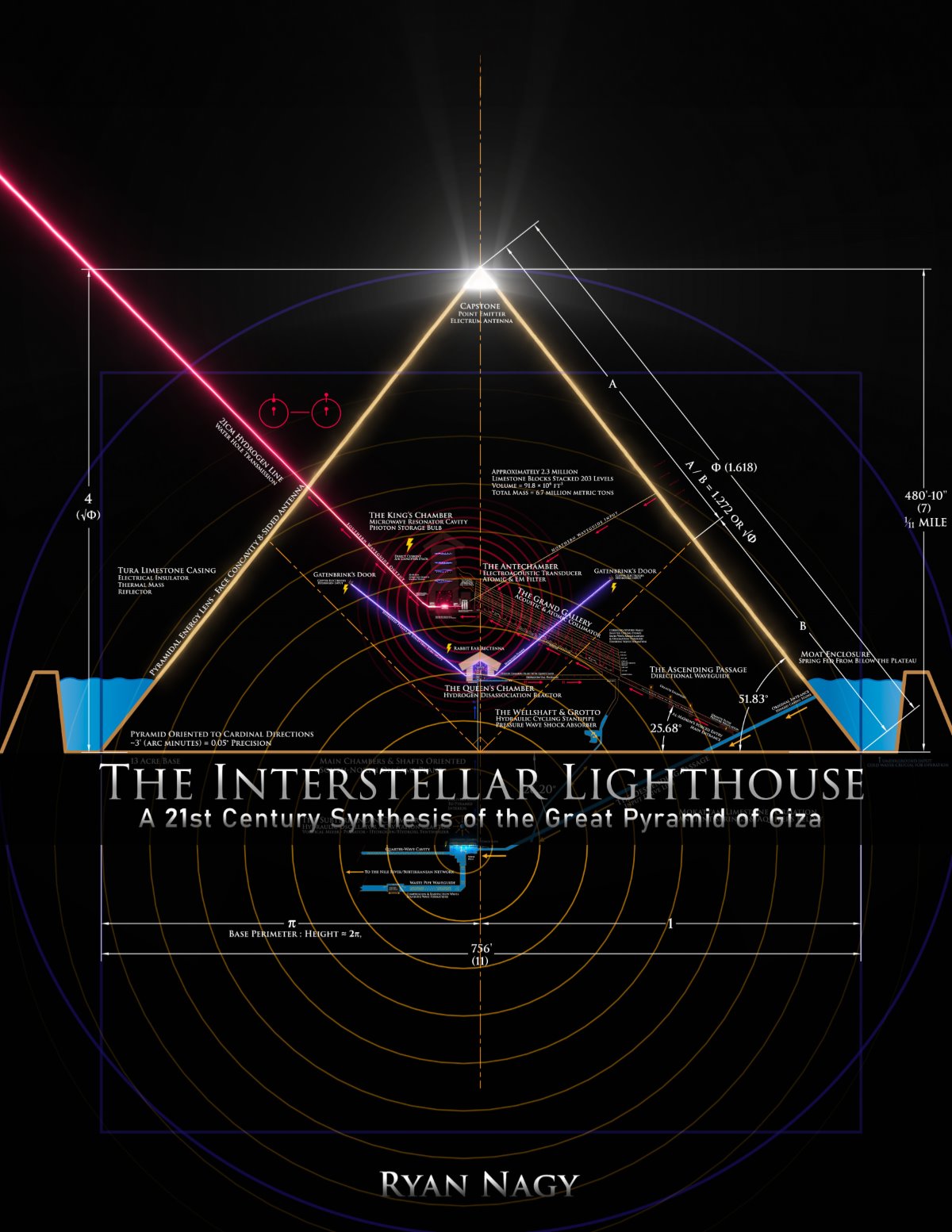
Those are the larger questions developed in The Interstellar Lighthouse. The funnel offers one geometric doorway into the book’s broader interpretation of the Giza Plateau.
To follow a form into its relationships is to ask how the world holds together, changes, and returns.
Continue into the larger work
The book develops Ryan Nagy’s interpretation of the Great Pyramid as a proposed interface between terrestrial and celestial processes. It follows water and pressure, chambers and resonance, proportion and orientation, and the possibility that architecture could organize natural cycles.
The accompanying exhibition opens that wider picture: the monument’s internal anatomy, the Giza setting, an astrophysical horizon, and the question of civilization’s relationship to a living planet.
This is the author’s interpretive research framework. The established archaeological account identifies the Great Pyramid as Khufu’s royal tomb; claims of a functioning geophysical or astrophysical instrument require independent evidence. Egypt’s Ministry of Tourism and Antiquities ↗
06 · Sources & further paths
The PKS archive documents his engineering background, harmonic research and hyperbolic-section models. It establishes the intellectual context; it does not identify the particular pyramid graphic remembered by the author.
Walter Schauberger · PKS biography ↗Results follow from r = 1/z and the stated cutting plane. The numeric angle, ratios and critical depth are calculations within this model. The expanded construction above states its coordinates and assumptions.
Revisit the derivation ↑A physical foundation for modes, boundary conditions and the harmonic series. Useful when turning a similarity of form into a proposed experiment.
OpenStax · University Physics, §16.6 ↗A. Einstein and N. Rosen, “The Particle Problem in the General Theory of Relativity,” Physical Review 48, 73–77 (1935). The historical bridge construction provides context for the analogy, not a physical model of this funnel.
Read the paper’s record ↗The Egyptian ministry’s account supplies archaeological context for Khufu’s monument. The movable pyramid in the interactive is a geometric construction, not a survey of the site.
Ministry of Tourism and Antiquities ↗Continue through water’s motion, resonance and planetary circulation, or explore the book that places this geometric study in a wider speculative framework.
The creative energy-vortex →