Documented history
A claim anchored to an identifiable text, object, event, or institutional record.
Evidence · Consent · Conscience
Reason, Liberty, and the Unfinished American Experiment
Who has the authority to define truth—and by what right do they govern others?
Before a new society can be built, the authority of the old one must become a question. What distinguishes knowledge from conviction, and conviction from a command that others must obey? New Atlantis begins with these questions—not with the assumption that humanity has already answered them.
Francis Bacon imagined a society transformed by organized discovery. Later thinkers examined the foundations of knowledge, the legitimacy of government, and the limits of religious coercion. Their arguments entered the intellectual world of the American founding alongside older classical and religious traditions. [01][17]
The founding took place in a society profoundly shaped by Christianity. Its federal constitutional system nevertheless prohibited religious tests for federal office, and the First Amendment protected both against congressional establishment of religion and against interference with its free exercise. Religious arguments and philosophical arguments both contributed to freedom of conscience. [20][21][23]
The result was a contested attempt to give reason, rights, and conscience a different relationship to power. This exhibition follows that attempt through books, institutions, declarations, and symbols. It asks what the dream promised, what its builders failed to honor, and what remains unfinished.
A claim anchored to an identifiable text, object, event, or institutional record.
An argument about the significance of the evidence, attributed to its historian or institution.
A thematic connection offered by this exhibition, with its interpretive character made explicit.
A proposed connection whose required evidence has not been established. It remains a question.
The questionCould society be deliberately improved rather than merely inherited?

Bensalem & Salomon’s House
Bacon’s stranded travelers encounter Bensalem, an orderly, hospitable, explicitly Christian society. Salomon’s House investigates nature and develops useful knowledge: medicine and agriculture, light and sound, instruments and machines. Inquiry is sustained by an institution, not left to the occasional achievement of an isolated thinker. [01]
Yet Bensalem is monarchical and hierarchical. Its researchers decide which discoveries to disclose and sometimes keep them secret even from the state. Bacon’s imaginative commonwealth therefore raises two questions together: what might knowledge accomplish for humanity, and who should control it?
“the knowledge of causes, and secret motions of things”Francis Bacon · New Atlantis
The title page gives the exhibition its recurring motif. An unfinished book invites us to consider an unfinished political promise. That is our symbolic connection, not a claim that Bacon supplied a ready-made constitutional blueprint.
Two images of renewal
In Revelation 21, the New Jerusalem descends from heaven: renewal comes through divine action. Bacon’s Bensalem places organized investigation within a Christian society. These visions share a concern with a transformed world, but they locate the source and means of renewal differently. [13][01]
One is a scriptural vision; the other is a literary commonwealth. Reading them together opens a question that will recur throughout the exhibit: is a better world something humanity awaits, something it discovers, or something it must build?
The comparison is thematic. Shared language of light, order, or renewal is a starting point for interpretation. A claim of historical transmission would additionally require evidence connecting particular texts, readers, decisions, or institutions.
The questionWhat makes a claim worthy of belief?
The decisive change was a demand that claims submit to examination—even when their authors enjoyed prestige.
Bacon belongs to the earlier scientific transformation that helped prepare the Enlightenment. Newton’s Principia, published in 1687, demonstrated how mathematical laws could connect diverse physical phenomena. Experimental institutions gave observation, criticism, and shared investigation a durable social setting. [02][05]
The Royal Society’s motto, Nullius in verba, is commonly rendered as “take nobody’s word for it.” Authority alone was insufficient; claims should face experimental evidence. That was a discipline of checking, not a promise that any institution—or any dissenter—would become infallible. [05]
The Enlightenment was neither a single philosophy nor a single organization. Its thinkers disagreed about experience, reason, religion, and political authority. Inquiry became more prominent without belief in God simply disappearing. [38]
Bacon’s discipline of doubt
The obstacle to knowledge may be an institution. It may also be the mind doing the investigating. [03]
Distortions rooted in common human tendencies. We may find more order, purpose, or agreement than the evidence supports.
The enclosure of personal education, temperament, and habit. Individual experience can quietly become the measure of everything else.
Confusion carried by words. A familiar name can conceal a poor distinction or make an untested idea seem like an established thing.
Inherited systems accepted as complete performances of truth. A persuasive story can win our allegiance before its foundations are examined.
An argument can be logically consistent while starting from false premises. Examine both the inference and what it assumes.
An observation may be genuine while fitting several explanations. Ask what would distinguish the alternatives.
Confidence should remain answerable to better evidence. A belief that cannot be revised cannot learn from inquiry.
These three questions are a contemporary method of reading, not a quotation from Bacon.
“the three greatest men that have ever lived, without any exception”
Thomas Jefferson asked John Trumbull for portraits of Bacon, Locke, and Newton together. The letter provides a direct documentary connection to the thinkers he admired. [04]
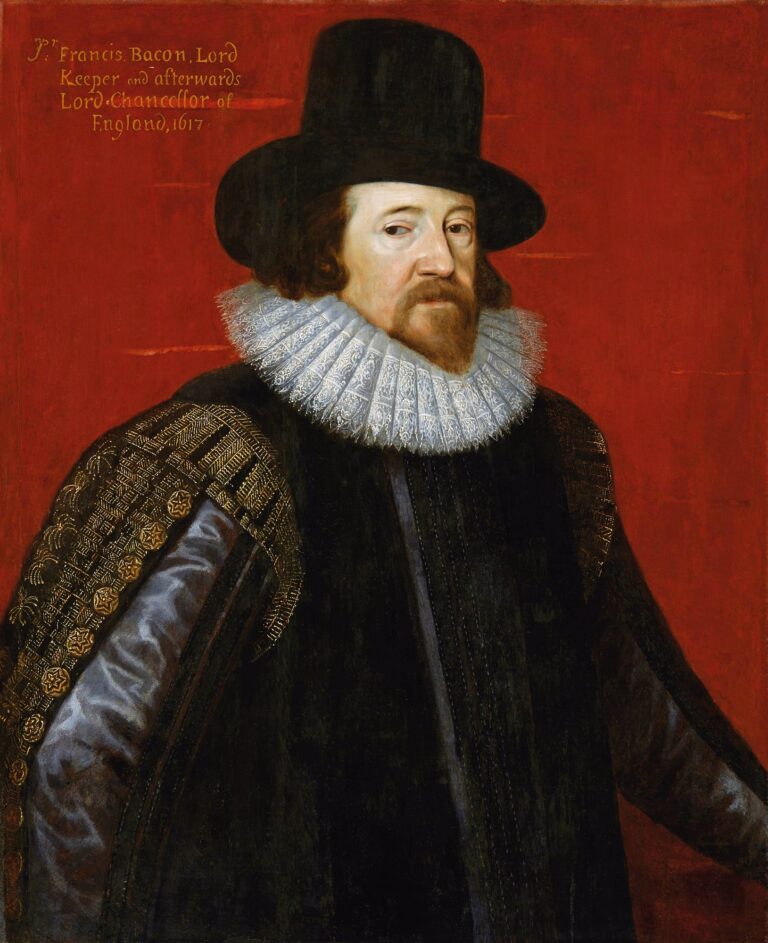
Rebuild knowledge through observation, experiment, and the correction of error. Bacon’s ambition was collective and practical: inquiry should enlarge what people can understand and do. [02]
Paul van Somer · 1617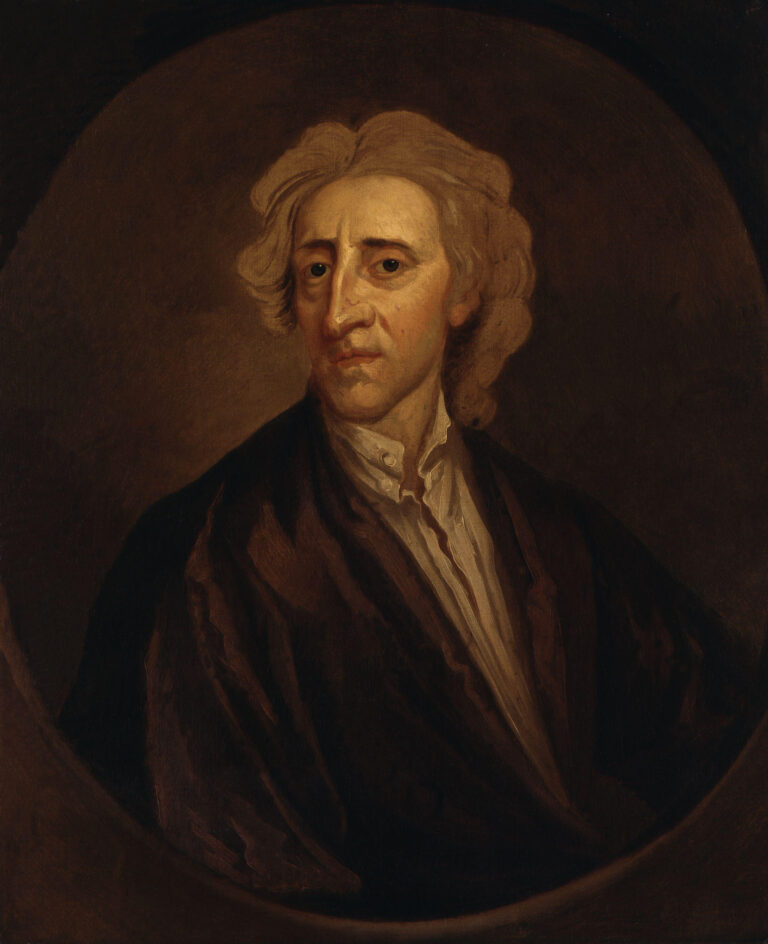
Begin with natural freedom and ask what authorizes one person to govern another. Political power is a trust directed toward the people’s preservation, with consent at its foundation. [06]
After Godfrey Kneller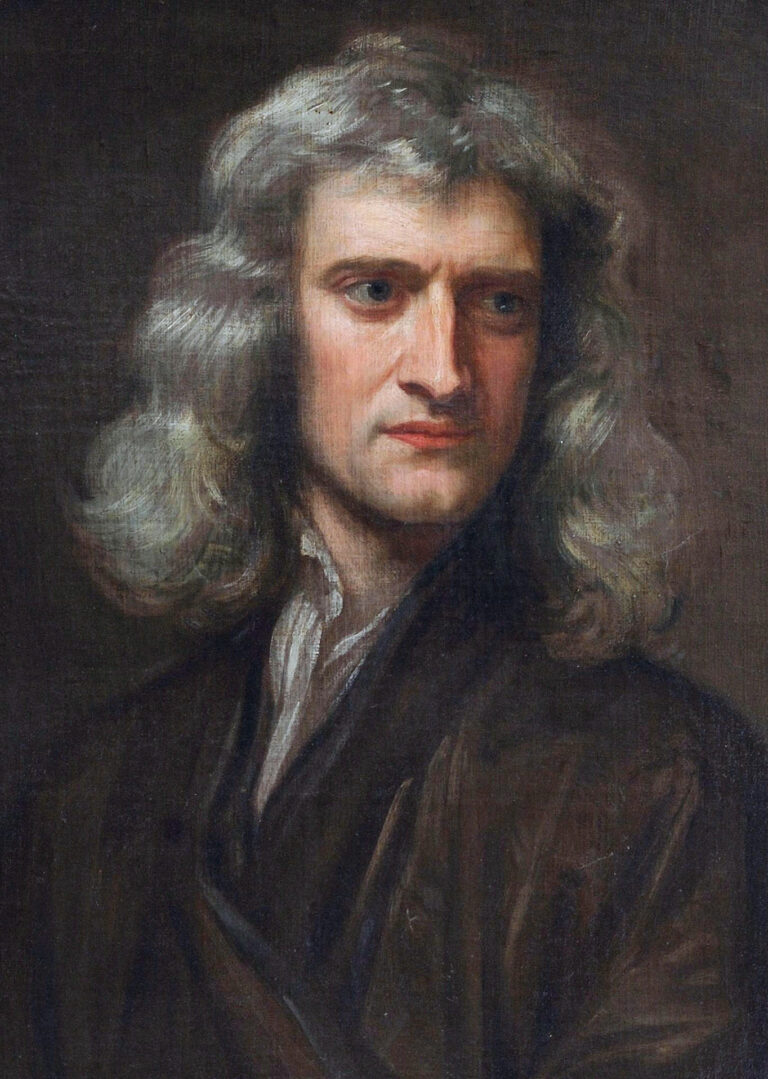
Give natural philosophy mathematical reach. The Principia offered a powerful example of the order that could emerge when observation and reasoning were brought together. [05]
Godfrey Kneller · 1689These are historical portraits, not the paintings commissioned by Jefferson. Makers and collection links appear in the image credits.
Jefferson’s admiration is explicit. The letter supports an intellectual relationship; it does not establish that these three thinkers supplied every founding principle or acted within one coordinated program. The next chapter follows several different routes from reading to political argument. [04][17]
The questionCan political authority be examined rather than simply obeyed?
If authority needs a justification, inherited power is no longer its own sufficient explanation.
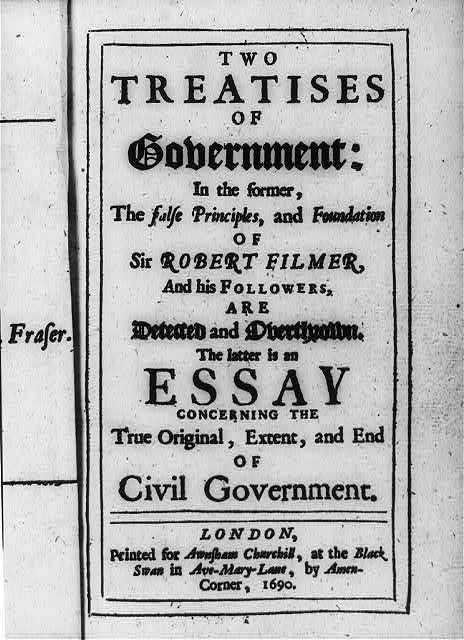
Locke starts from natural freedom and equality. People possess rights before government; political society is formed through consent and public power is entrusted for their preservation. A government’s legitimacy depends on the purposes it serves, not simply on the fact that it can command. [06]
His Letter Concerning Toleration also distinguishes civil interests from the care of souls. A magistrate’s ability to compel outward behavior does not give that official command of inward conviction. The argument creates a powerful limit on coercion, even though Locke’s own toleration was not without exclusions. [18]
The movement from natural law to political rights is an argument, not a deduction from physics. Newton’s mathematical success did not prove a constitution. Thinkers had to ask additional moral and political questions about persons, obligations, consent, and the proper use of force.
Liberty requires attention to how governmental powers are arranged. Madison’s Federalist No. 47 explicitly engages Montesquieu while asking how the legislative, executive, and judicial powers may be connected without being concentrated in the same hands. [08]
Common Sense attacks hereditary monarchy and argues for independence in language addressed to a broad public. Political ideas become forces through circulation, persuasion, and debate, as well as through philosophical books. [16]
The Declaration joins rights and consent to a concrete case for separation. It appeals to a Creator and Providence while presenting reasons for the political act it announces. [07]
Madison’s arguments connect constitutional design with limits on domination. His work in Virginia also joins institutional politics to an insistence that religious conviction cannot properly be commanded by force. [08][22]
More than one inheritance
Looking back in 1825, Jefferson named Aristotle, Cicero, Locke, and Algernon Sidney among the sources of public-right thinking behind the Declaration. His account places classical political thought and earlier constitutional arguments alongside Enlightenment philosophy. It is a retrospective explanation of the intellectual climate, not a line-by-line list of borrowed phrases. [17]
Ideas also met an immediate imperial conflict. The Declaration lists grievances involving taxation, representation, legislation, courts, military power, and administration. Independence emerged from arguments about actual acts of government, not simply from philosophers designing a nation on paper. [07]
An influence ledger: each connection names the relationship supported by its record.
Spinoza’s criticism of religious authority, Voltaire’s campaigns against intolerance, Diderot’s encyclopedic project, Rousseau’s account of political association, and Hume’s skepticism open different paths through the period. They help us see an intellectual world of disagreement, not a single doctrine. Their relevance here does not make each an equally direct influence on every American founder. [38]
The questionDoes a religious population require a religious state?
Christian influence and Enlightenment influence were not mutually exclusive. The sharper question concerns jurisdiction: what authority does government possess over belief, worship, and civil standing?
The founding documents perform different jobs. A declaration explains independence; a statute changes a jurisdiction’s law; a constitution establishes institutions; amendments place further limits on them. Reading the documents together preserves distinctions that an isolated quotation can blur.
Establishes: a public argument for independence using equality, rights, consent, a Creator, and Providence.
Scope: its religious language is real, but the document does not prescribe a Christian confession or establish a national church. [07]
Read the document ↗Establishes: rejection of compulsory religious support and protection of civil standing from religious belief or opinion.
Scope: a Virginia law, rooted in an argument about freedom of mind. Its passage did not by itself change every state’s arrangements. [19]
Read the statute ↗Establishes: federal institutions and, in Article VI, a prohibition on religious tests for offices or public trusts under the United States.
Scope: this is a qualification rule for federal public service, not a requirement that citizens or officials abandon personal religious commitments. [20]
Read Article VI ↗Establishes: protection against congressional establishment of religion and against prohibition of its free exercise.
Scope: both clauses matter. The original wording addresses Congress; 1791 was not an instant nationwide completion of religious equality. [21][23]
Read the amendment ↗Believers against coercion
Roger Williams grounded liberty of conscience in deeply held religious convictions. Civil rulers, in his view, could preserve public order without possessing authority over the soul. His position makes clear that separation could be defended for religious reasons. [24]
In Virginia, Baptists and Presbyterians joined Madison and Jefferson against government-supported religion. Baptists had experienced persecution, and religious opponents of the assessment argued that state support could corrupt faith itself. [23]
Madison’s Memorial and Remonstrance treats religious conviction as a matter of reason and conviction beyond the proper reach of force. Conscience precedes the authority of civil society; it is not merely a privilege that a tolerant ruler can grant and revoke. [22]
That coalition did not require agreement about theology. People who disagreed about religious truth could still oppose a government’s power to compel religious support. Liberty of conscience could protect believers from other believers wielding state authority.
State practices remained uneven. The Library of Congress’s collection records arrangements for religious taxation in New England alongside the Virginia struggle against assessment. Federal restrictions and state institutions followed different histories; the protections described here developed through further conflict and change. [23][21]
“not in any sense founded on the Christian Religion”
The English Article 11 describes the government of the United States this way while promising that religious opinions would not disrupt peace with Tripoli. That English version was submitted to the Senate and ratified by the United States in 1797. It is evidence of an official diplomatic position. [25]
The corresponding article does not appear in the surviving Arabic text. Hunter Miller’s documentary edition identifies a letter in its place and explains that the English rendering was accepted in the United States despite substantial differences from the Arabic. [26]
Both facts belong in the exhibit: the words were officially approved in English, and their claimed equivalence to the Arabic is defective. The treaty should be read in its diplomatic and translation history, alongside the constitutional documents.
The questionWhat did these associations teach—and what social functions did they serve?
Freemasonry belonged to the social world of the founding generation. Washington and Franklin were members; lodges brought people into recurring relationships of ritual, fellowship, and obligation. [30]
The 1723 Constitutions offer a more useful entry than modern conspiracy imagery. They describe moral obligations and seek common religious and ethical ground while leaving particular opinions to individuals. Their toleration was not a declaration of atheism. [28]
UGLE’s historical account emphasizes education, civility, personal improvement, written rules, elections, and accountability within the association. It also cites the persistence of hierarchy and aristocratic patronage. Fraternal ideals operated within unequal societies. [27]
The documented project included shaping conduct and sustaining fellowship. It also connected people with social influence. These functions can be studied together: ethical aspiration does not erase social power, and social power does not establish a single hidden government.
Admission into the craft and the beginning of a structured moral education.
Further learning, using the language of skilled work and intellectual improvement.
The third degree, extending the craft’s moral and symbolic instruction.
An introductory reading of the degree sequence. Building tools and workmanship function as ethical metaphors; ceremonies and their development require their own historical context. [29]
Mount Vernon distinguishes the revolutionary activity of individual Freemasons from the political neutrality of the fraternity and its local lodges during the Revolution. Membership establishes association; a stronger claim that a lodge directed a political act needs evidence of the act, instruction, decision, or coordinated effort itself. [30]
UGLE’s interpretation is an institutional account of its own tradition. It is useful evidence of how the tradition explains its values, and should be read with that standpoint in mind. [27]
The questionCan a movement promote independent judgment through secrecy and supervision?
Adam Weishaupt founded the Bavarian order in 1776. It was a distinct organization with identifiable members, correspondence, methods, and political ambitions.
LMU Munich describes its aim as forming an educated and supervised elite that could occupy key state positions and weaken the rule of territorial princes. This was a strategy for social and political influence, not merely private philosophical conversation. [31]
Weishaupt’s 1776 letters to Franz Anton von Massenhausen make recruitment concrete. He sought capable, industrious, socially connected, wealthy, and powerful men. He assessed manners and character, discussed access to noble households, and encouraged the collection of books. The record shows deliberate organization. [32]
That mechanism raises a tension at the heart of this exhibition: a movement seeking liberation from inherited authority can reproduce authority through its own hierarchy, supervision, and management of information.
Education and reform, coupled with ambitions to influence state institutions. An organization’s stated purpose is evidence of intention, not proof of its accomplishments. [31]
Recruitment, correspondence, assessment of members, useful connections, and instruction. The letters allow these mechanisms to be examined directly. [32]
Bavarian suppression in 1784–1785 disrupted the order. Archival research at Gotha identifies continued activity into 1787, extending its documented history beyond the ban. [12]
Claims of a permanent world administration require a chain of evidence beyond eighteenth-century membership or shared symbols. The documents presented here do not supply that chain.
LMU’s account follows former members into later careers, including Montgelas’s appointment as a Bavarian chief minister in 1799. The Gotha research follows the order’s surviving records into 1787. These are specific continuities that can be investigated. A former member’s later office is not, by itself, proof that an unchanged secret organization controlled that office. [31][12]
No documentary chain establishing such continuity is presented in this exhibition. Bacon’s literary academy, Masonic lodges, and Weishaupt’s order are different historical subjects. Connections should be made through dated records of contact, transmission, membership, or coordinated action, with the strength of the claim matched to the evidence.
Select a date to open its historical note and source.
Bacon’s Novum Organum calls for disciplined inquiry and attention to the habits that distort judgment. It proposes a renovation of knowledge rather than a new article of faith.
Read the source ↗The questionWhat did the people who designed these symbols say they meant?
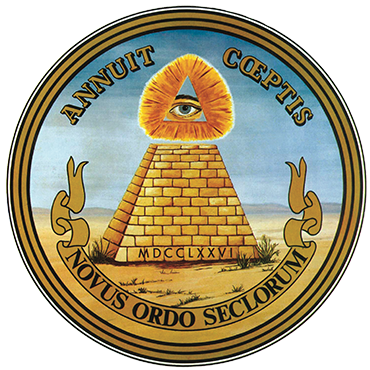
1782 / The adopted emblem
Congress adopted the Great Seal on June 20, 1782. Charles Thomson’s explanation links the pyramid to strength and duration, the eye to Providence, and the lower motto to a new American era. Those explanations give the inquiry its documentary starting point. [09]
The two sides appeared together on the one-dollar bill in 1935. The adoption of an emblem and its later mass circulation are different events. Keeping the dates separate helps prevent a familiar modern object from collapsing several histories into one. [10]
Thomson’s explanation gives the pyramid these meanings. The official design shows thirteen courses, corresponding to the original states. Its incomplete summit remains a feature of the emblem, not evidence by itself of a hidden organization.
Consult the record ↗Before the adopted design
John Adams’s August 14, 1776 letter to Abigail records Franklin proposing Moses, the divided Red Sea, and Pharaoh overwhelmed by the waters. Jefferson proposed the Israelites in the wilderness, guided by cloud and fire. These were proposals, not the design eventually adopted. [34]
The episode joins biblical imagery to revolutionary politics within the same design conversation. It complicates any account that places religious symbolism and Enlightenment argument in wholly separate camps. The founders could use several inherited languages to express a political beginning.
The Eye of Providence also appears in Freemasonry. The Scottish Rite’s own account places it within a wider religious symbolic history and distinguishes the Great Seal from a Masonic emblem. A shared visual vocabulary can explain resemblance; authorship and organizational direction require additional records. [35][33]
Bacon’s title page identifies New Atlantis as “A Work unfinished.” The pyramid also rises without a completed summit. This exhibition places those forms together as an image of promises that remain open to judgment and further construction. The pairing is a curatorial motif; the visual resemblance does not establish a secret transmission from Bacon to the seal’s designers.
This schematic was drawn for the exhibit to isolate the basic elements. The government-sourced reproduction above is the historical visual reference.
The questionWho received these liberties—and who had to struggle to make them apply?
Principles can exceed the people who first proclaim them.
The original constitutional settlement accommodated slavery. It included the three-fifths apportionment rule, a fugitive-slave provision, and a protection against a congressional ban on the importation of enslaved people before 1808. These arrangements gave institutional form to exclusion; they were not small deviations from an otherwise completed equality. [20]
Jefferson’s own participation in slavery exposes the contradiction within the person whose intellectual admiration anchors this exhibit. The language of liberty must be read beside the relationships that denied it. [15]
Wollstonecraft’s 1792 argument for women’s education and rational independence pressed another boundary: if reason belongs to humanity, why are its opportunities distributed so narrowly? The language of an age could become an instrument for challenging its exclusions. [14]
Abolition and voting rights required sustained struggle and constitutional change beyond the founding generation. The Thirteenth Amendment in 1865 abolished slavery and involuntary servitude, with an exception for punishment after conviction. The Nineteenth Amendment in 1920 prohibited denial of voting rights on account of sex, while discriminatory barriers continued to obstruct many women. [36][37]
Does the society protect people whose convictions the majority dislikes?
Can institutions justify their authority, disclose their conduct, and be challenged?
Can excluded people use a society’s own principles to transform its arrangements?
No institution is beyond examination
because it claims privileged access to truth.
The concern of New Atlantis is not whether an earlier generation possessed the final truth. It is whether later generations retain the freedom—and accept the responsibility—to keep searching. The experiment remains unfinished wherever evidence cannot challenge certainty, conscience is coerced, or public power cannot answer to the people it governs.
Continue the inquiryThe Land of MonopolyThat exhibition examines how power concentrates. New Atlantis asks how power is justified, limited, and challenged.
A sub-exhibit of New Atlantis
Number, Measure & the Cosmos
A separate study follows the numerical thread from Revelation’s measured city to the Earth–Moon comparison and In’Spire’s Universal Program. Examine the proportions, inspect the units, and explore the proposed connections.
Enter the sub-exhibitPrimary documents, historical collections, and attributed interpretation behind the expanded exhibition.
Bensalem, Salomon’s House, Christianity, experimental research, and the decision to publish or withhold discoveries.
Bacon’s case for a reformation of learning through disciplined inquiry.
The four idols: shared human tendencies, individual habits, language, and inherited systems.
A direct documentary link: Jefferson requests portraits of Bacon, Locke, and Newton together.
The Society’s first meeting in 1660; its experimental practices and motto.
Natural freedom, consent, property, political trust, and the limits of government.
The Declaration’s claims about equality, rights, consent, and political authority.
Madison’s explicit engagement with Montesquieu on the separation of powers.
The adopted symbolism and Thomson’s explanation of the pyramid, Providence, and a new American era.
The Great Seal’s appearance on the one-dollar note in 1935.
Washington’s documented Masonic participation, beginning in 1752.
Archival research on the order founded in 1776, the Bavarian ban of 1785, and continued activity through 1787.
The New Jerusalem as a holy city descending from heaven.
A contemporary argument for women’s rational capacity and education.
The contradiction between the language of liberty and Jefferson’s participation in slavery.
The public argument against hereditary monarchy and for American independence.
Jefferson’s retrospective account of the Declaration names Aristotle, Cicero, Locke, and Sidney.
Civil interests, religious belief, and the limits of the magistrate’s jurisdiction.
Compulsory religious support, freedom of religious argument, and civil standing.
Article VI’s religious-test prohibition; the original settlement’s accommodations of slavery.
The establishment and free-exercise clauses, addressed in the original text to Congress.
A primary argument against religious assessments and coercion of conscience.
Baptist and Presbyterian opposition to religious assessments, the Virginia campaign, and differing state arrangements.
A religious argument for limits on civil authority over belief and worship.
The English text submitted to the Senate, including Article 11, and the 1797 ratification record.
The discrepancy between Article 11 in the English version and the surviving Arabic document.
Religious toleration, education, written rules, elections, and the persistence of hierarchy.
The text’s appeal to shared religion and ethics while leaving particular opinions to individuals.
Building metaphors and the progression through Entered Apprentice, Fellowcraft, and Master Mason.
Washington and Franklin, elite sociability, and the distinction between individual political action and institutional neutrality.
The order’s founding, elite education and supervision, ambitions for state office, and the later careers of former members.
Recruitment instructions to Franz Anton von Massenhausen and the qualities sought in members.
Official seal reproductions, the successive proposals, and Thomson’s explanation.
Franklin’s Moses and Pharaoh proposal and Jefferson’s Israelites in the wilderness.
A Masonic account of the eye’s wider religious history and its use in the Great Seal.
Constitutional abolition of slavery, including the text’s exception for punishment after conviction.
The prohibition on denying voting rights on account of sex, and the barriers that remained.
Debates over knowledge, religion, politics, and the diverse projects associated with the Enlightenment.
Historical portraits: Francis Bacon, Paul van Somer, 1617; John Locke, after Godfrey Kneller; Isaac Newton, Godfrey Kneller, 1689. Public-domain reproductions from Wikimedia Commons. These are not the paintings commissioned by Jefferson.
Historical title pages: New Atlantis, 1628 edition, public domain; Two Treatises of Government, 1690, Library of Congress, no known publication restrictions.
Great Seal: U.S. Department of State reproduction of the reverse, supplied by the American Revolution Institute. This is an official depiction of the emblem, not a photograph of an original 1782 reverse die. The expandable line drawing is a simplified interpretive diagram made for the exhibit.
Original illustrations: Bensalem and the interior of Salomon’s House are AI-assisted artworks created for Infinity Envisioned in 2026. They imagine Bacon’s fiction and are not archival evidence.
Editorial approach: This contemporary exhibition takes visual inspiration from early modern folios. Chapter questions and concluding propositions are curatorial interpretations. Source panels identify documentary history, scholarly interpretation, symbolic reading, and unverified claims. Institutional accounts of Freemasonry are identified as such.


