Die Vergiftung · Contamination, treatment & the modern load
A civilisation can be read by what it puts in its water.
Water carries a history of everything it meets. In a spring, that history may be mineral and geological; beneath a farm, road or factory, it may also include compounds that were never part of an aquifer’s natural cycle.
This is where Schauberger’s language of living water meets the practical record of modern water management. The danger is real, but precision matters: detecting a substance is not the same as exceeding a health limit, ecological harm is not automatically human harm, and no single filter answers every problem. Urgency becomes useful when it is paired with measurement.
Groundwater supplies about half the water withdrawn globally for domestic use and roughly one-quarter of irrigation water. Once contamination enters an aquifer, cleanup is difficult, expensive and often slow. Depending on geology and chemistry, restoration can take years to centuries, and some plumes cannot be fully removed. Prevention and early detection therefore matter enormously. UNESCO: Groundwater
Blue particles show water; colored particles show potential contaminants. Pumping draws groundwater toward the screened intake, then lifts water and the contaminants it carries up the well to the supply. The upper casing is sealed; entry occurs through the aquifer screen. Some pollutants are degraded or retained in soil, and travel depends on chemistry, geology and flow. This schematic compresses time and does not represent measured concentrations. The added pathways depict a failing septic system and landfill leachate escaping containment. USGS groundwater quality · EPA: septic impacts · EPA: landfill leachateField record / United States
A national problem, measured below the surface.
The burden is large, but it cannot honestly be reduced to one percentage of "America's groundwater." These studies measure different aquifers, chemicals and time periods. Together, they show how widely contaminants travel—and why their concentrations matter.
PFAS · modeled occurrence · 202471–95 million
People whose groundwater source may contain PFAS
A USGS model estimates that this many people in the contiguous U.S. may rely on groundwater with detectable PFAS, before treatment. It used 1,238 samples tested for 24 PFAS.
A source-water estimate, not a count of people drinking unsafe tap water. The model predicts detection, not concentration. USGS · 2024 study ↗
Private wells · health benchmarks23%
At least one contaminant above a health benchmark
In a national USGS assessment, 23% of the 1,389 domestic wells tested for the study's broad contaminant suite exceeded at least one regulatory or nonregulatory health benchmark.
Samples collected 1991–2004, before household treatment; report published 2009. A historical baseline, not a current census of private wells. USGS · domestic-well assessment ↗
Nitrate · agricultural study areas22%
Domestic wells above the nitrate limit
About one in five domestic wells in the assessment's agricultural areas had nitrate above 10 milligrams per liter as nitrogen. Fertilizer and manure can leave a legacy below the root zone.
USGS nutrient assessment, 1992–2004. This is a finding for agricultural study areas, not 22% of every U.S. well. USGS · nitrate findings ↗
Pesticides · public-supply wells41%
Pesticides or their breakdown products detected
A study of 1,204 public-supply wells found pesticide compounds in 41%. Concentrations were low: none exceeded the study's measured or estimated health-benchmark levels, including its mixture screening.
Published 2021; tested 109 pesticides and 116 breakdown products. Detection does not itself establish a health hazard. USGS · pesticide assessment ↗
The geography of persistence
Contamination has a landscape.
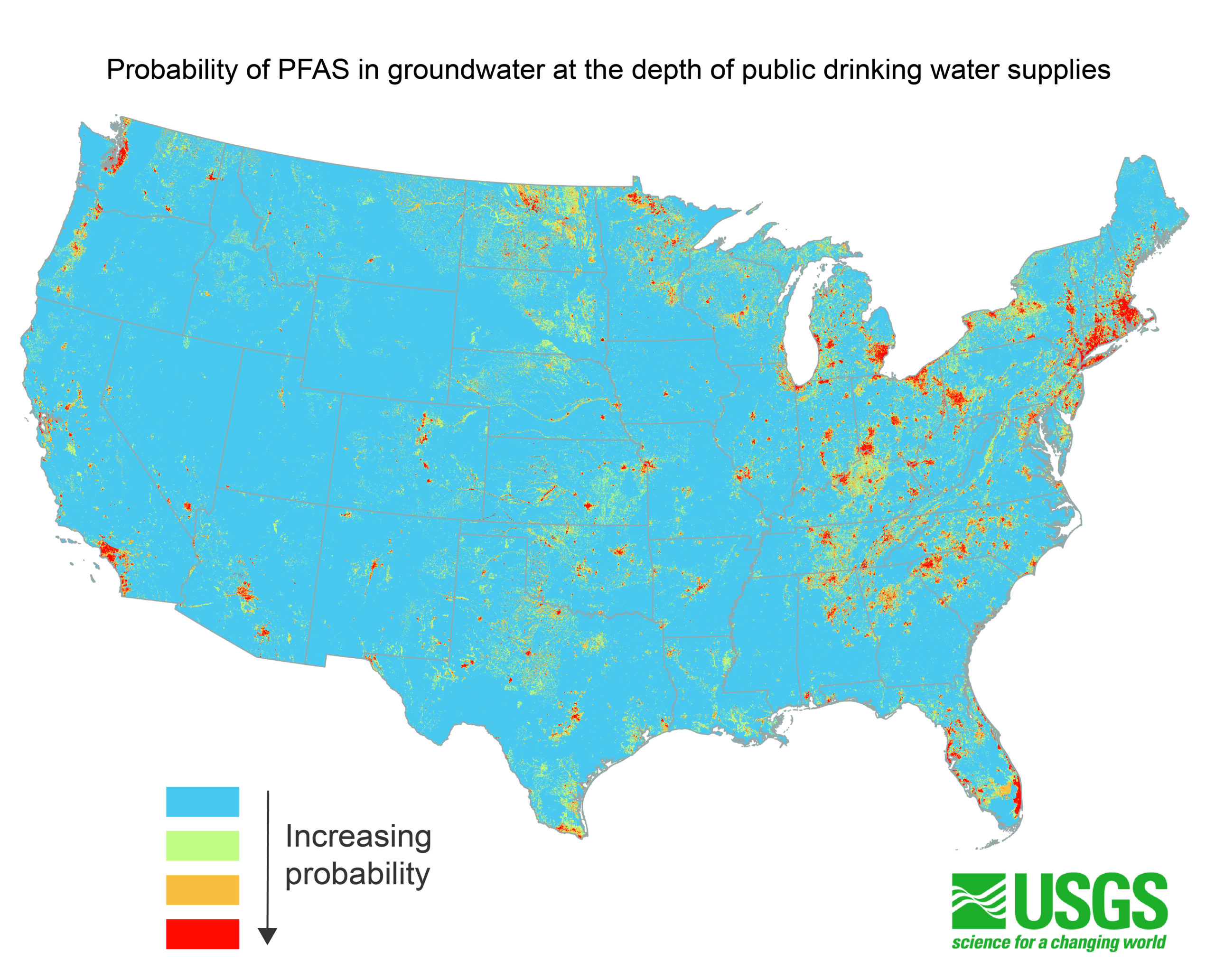
This 2024 USGS map estimates the chance of detecting PFAS at the depths used by public-supply wells. Private wells often draw from different depths, so their pattern differs.
The map is useful at regional scale. It cannot tell you what is in an individual well or what remains after treatment.
USGS, October 2024 · public-domain map, original legend retained. Color represents probability of detection, not pollution concentration. Select the map to enlarge. Map source and study ↗
Public-supply groundwater · 2022 assessment
Some of the burden comes from the rock itself.
Industrial and agricultural pollution are only part of the record. A study of 25 principal aquifers—accounting for 84% of groundwater pumped for U.S. public supply—found elevated naturally occurring constituents more frequently than human-derived contaminants.
Naturally occurring constituents35%
Human-derived constituents8.1%
0%100% of sampled wells
The study's detection-frequency measure for concentrations above regulatory or nonregulatory human-health benchmarks. Categories can overlap; do not add them. These are source-water findings, not public-system compliance rates or percentages of all groundwater by volume. Belitz and colleagues · 2022 ↗
Arsenic · a geological exposure
Clear water can carry a hidden load.
2.1 million people
A 2017 model estimated that about 2.1 million private-well users in the contiguous U.S. could draw groundwater with arsenic above 10 micrograms per liter. The 95% uncertainty interval was 1.5–2.9 million.
Built from 20,450 domestic-well measurements, this is a population estimate at the time of the study, not a current household test. Naturally occurring does not mean harmless. USGS · arsenic model ↗
Long-term monitoring · 2025 report
There is evidence of improvement, too.
7% → 2%
Across the study's well networks, the share with moderate pesticide concentrations fell from 7% in 1993–2001 to 2% in 2013–2022. Agricultural networks fell from 13% to 4%.
Here, "moderate" means above one-tenth of a health benchmark, up to the benchmark itself. The analysis tracked 22 pesticides; it does not measure all chemicals or prove an aquifer is clean. USGS · three-decade assessment ↗
How to read these numbers
Source water and tap water
Groundwater sampled at a well may be treated or blended before it reaches a tap. A groundwater finding does not establish the concentration in the water someone drinks.
Detection and exceedance
A detection means an analytical method found a compound. An exceedance compares its concentration with a specified benchmark. Some benchmarks are regulatory; others are health-based guidance.
Different studies, different denominators
These figures describe modeled populations, sampled wells or selected well networks. They cannot be added, ranked as one survey, or converted into a percentage of U.S. groundwater volume.
Dates are part of the evidence
National assessments take years to assemble. Older measurements remain valuable baselines, but comparing separate surveys is not a trend analysis. The pesticide trend study follows a consistent set of compounds over time.
Evidence reviewed · Publication and sampling dates shown with each finding.
Agricultural load
Nitrate and pesticides
Nitrate from fertilizer and manure is widespread in shallow groundwater beneath agricultural land and can threaten infants above the drinking-water limit. Atrazine and its metabolites occur in some agricultural aquifers; glyphosate and AMPA are detected less often in groundwater than in soil and surface water. Concentration, mixture, location and exposure determine risk.
Persistent chemistry
PFAS
PFAS are a large, diverse class. Many legacy compounds—including PFOA and PFOS—are exceptionally persistent, and some bioaccumulate. A 2023 USGS tap-water study estimated at least one of 32 tested PFAS in roughly 45% of U.S. tap water. That estimate includes public and private supplies; it is not a groundwater-only statistic. Certain PFAS exposures are linked to immune, liver, thyroid, developmental and cancer risks; evidence is still limited for many others.
Road runoff
Tire wear and 6PPD-quinone
Tire particles wash from pavement into streams with stormwater. Research identified 6PPD-quinone—formed when a tire preservative reacts with ozone—as a potent driver of acute coho salmon mortality. Sensitivity varies greatly among species, but the finding shows how a familiar material can create a previously unrecognized aquatic hazard.
Wastewater load
Pharmaceutical residues
Conventional wastewater plants do not specifically target pharmaceuticals, although removal varies by compound and process. Residues and endocrine-active mixtures can enter receiving waters; fish near some outfalls show altered reproductive development. Antimicrobial residues, resistant organisms and resistance genes are also environmental concerns. These ecological findings do not by themselves prove human harm from trace drinking-water exposure.
Know what you are consuming
A clear glass is not a laboratory result. Taste, odor, color and a total-dissolved-solids meter can reveal useful clues, but none can establish safety on its own. Spring water and bottled water are not automatically cleaner than regulated tap water.
A practical water-reading ritual
Start with the water you actually have, identify the measured concern, and choose a response that is certified for that concern.
Public system
Read the annual report
Find your utility’s Consumer Confidence Report, then check local lead, nitrate and PFAS notices. Ask the utility or health department about changes, exceedances and the sampling location nearest you.
Private well
Test, do not guess
EPA recommends annual certified-lab testing for total coliform bacteria, nitrate, total dissolved solids and pH, plus contaminants relevant to nearby agriculture, industry, spills, septic systems, flooding or local geology.
Treatment
Match the device to the result
Look for independent certification naming the contaminant you need reduced, then follow flow-rate and cartridge-replacement instructions. A filter that reduces chlorine may not reduce nitrate, lead or PFAS.
Advisories
Know which warning you received
Boiling kills many germs but does not remove chemical contamination and can concentrate some dissolved chemicals. “Boil water,” “do not drink” and “do not use” notices require different actions—follow the issuing authority.
Fluoride: chemistry, industry and the civic bargain
The history is neither a simple public-health triumph nor proof of a disposal conspiracy. Fluoride can act at the tooth surface, swallowed fluoride circulates through the body, excessive exposure is harmful, and important lower-dose questions remain under review. The Water Bearer's Codex therefore asks a prior civic question: should a substance intended for a dental effect be placed in a shared water supply when individual dose, susceptibility and consent cannot be controlled?
1931 · Industrial clue
An Alcoa laboratory enters the story
H. V. Churchill, chief chemist for the Aluminum Company of America, identified unusually high fluoride in water at Bauxite, Arkansas while investigating mottled enamel. That industrial connection is documented; it does not establish that fluoridation was invented as a waste-disposal scheme. NIH history
1945 · Grand Rapids
A city becomes the field trial
At 4 p.m. on January 25, Grand Rapids began feeding sodium fluoride into its water. The city was paired with unfluoridated Muskegon in a planned 15-year community study. It was a population field trial, not a randomized clinical trial. CDC timeline
1950–1951 · Adoption
Policy outran the original control
National endorsements arrived after the five-year review. Muskegon began fluoridating in July 1951, ending the original two-city control comparison long before the planned 15 years, although Grand Rapids examinations continued and reported lower childhood caries.
Today · Reassessment
An old policy meets newer evidence
Fluoride toothpaste changed the baseline, and a 2024 Cochrane review found the added dental benefit of fluoridating water is probably smaller now than in pre-toothpaste studies. EPA is conducting an updated health assessment. Cochrane review
Industrial lineage · precisely stated
Recovered from phosphate processing
The most widely used U.S. additive is fluorosilicic acid. EPA describes it as a byproduct of wet-process phosphoric-acid production: fluoride-bearing gases from phosphate rock are scrubbed with water, forming a recovered process waste stream. Sodium fluorosilicate is generally derived from the same fertilizer-industry route. Sodium fluoride, the compound first used in Grand Rapids, is manufactured differently. Calling every additive “aluminum waste” is inaccurate; calling much of the modern supply a recovered phosphate-fertilizer byproduct is exact. Modern products are expected to meet the NSF/ANSI 60 water-treatment standard. EPA supply-chain profile
Why origin still matters
Transparency is part of consent
An industrial origin does not by itself determine toxicity; dose, chemical form and impurities do. But a public utility should disclose the exact additive, manufacturer, certificate of analysis, contaminant testing, target concentration and daily dosing records. The fact that the same ion can be a useful treatment chemical or a toxicant at another dose is a reason for precise monitoring—not for euphemism or reflexive dismissal.
Established physiology
Swallowed fluoride is systemic
Most soluble fluoride that is swallowed is absorbed through the gastrointestinal tract. The kidneys remove much of it; a portion is retained mainly in teeth and bone. Dental fluorosis from excess intake during enamel formation is established, and prolonged much-higher exposure can cause skeletal fluorosis. This is not a purely topical exposure once it is in the glass.
Neurodevelopment
A high-exposure signal, a lower-dose question
In 2024, the National Toxicology Program found moderate-confidence evidence associating higher exposure—represented mainly by drinking water above 1.5 mg/L—with lower childhood IQ. It found insufficient evidence to determine whether the U.S. target of 0.7 mg/L has that effect. That boundary should prevent both claims of proven harm at 0.7 and claims that the question is closed. NTP review
Endocrine and thyroid
Relevant at high dose; unresolved at the target
Thyroid changes have been reported most consistently in higher-exposure populations, with iodine status and other confounders affecting interpretation. EFSA's 2025 assessment reviewed possible thyroid effects alongside developmental and bone outcomes, with uncertainty at lower exposure levels. Current evidence does not establish broad endocrine injury at 0.7 mg/L; total intake, life stage and susceptibility still matter. EFSA · 2025 assessment
Endocrine context · fluoride, mineral and biological night
The pineal gland and the inner night
Where daylight becomes a hormonal rhythm
The pineal gland is a small, richly supplied endocrine organ near the centre of the brain. Its pinealocytes produce melatonin, a hormone that communicates biological night and helps coordinate circadian timing. Light information reaches the brain's master clock—the suprachiasmatic nucleus—through the retina. A sympathetic nerve pathway then regulates norepinephrine release at the pineal gland. This clock-controlled signal promotes nighttime melatonin production; light at night can suppress it. Endotext · pineal physiology
The tryptamine chemistry of ordinary endocrine life
The essential amino acid tryptophan supplies the pathway below. Serotonin is 5-hydroxytryptamine; melatonin is N-acetyl-5-methoxytryptamine. These related indoleamines have distinct functions. Within pineal cells, AANAT converts serotonin to N-acetylserotonin; ASMT completes the conversion to melatonin. The relevant story here is a regulated biochemical pathway connecting environmental timing to hormone production.
Tryptophan01 · amino acid precursor
5-HTP02 · 5-hydroxytryptophan
Serotonin03 · 5-hydroxytryptamine
N-acetylserotonin04 · AANAT conversion
Melatonin05 · ASMT conversion
Sequence follows Endotext · melatonin synthesis. Melatonin is also made elsewhere in the body; the pineal is the principal source of the circulating nighttime signal.
Why fluoride can accumulate here
Sodium fluoride dissolves into sodium and fluoride ions. The relevant affinity is fluoride's interaction with calcium-phosphate mineral, rather than a demonstrated unique attraction of intact sodium fluoride to pineal cells. Pineal concretions contain carbonate-hydroxyapatite, a mineral related to that in bone and teeth. Fluoride can replace hydroxyl groups within apatite and become incorporated into its crystal structure. The gland's substantial blood supply and permeable capillaries provide a plausible route from circulating fluoride to these deposits. Pineal mineral analysis · Luke · mineral affinity
What the human tissue measurements show
Jennifer Luke's 2001 study examined 11 cadavers aged 70–100. Whole-pineal fluoride ranged from 14 to 875 mg/kg wet weight and correlated with calcium content. The table reports means ± standard deviations on the same wet-tissue basis. Luke · human autopsy study
Fluoride in Luke's elderly human sample · mg F/kg wet tissue
Measured tissue
Mean ± SD
Whole pineal gland
297 ± 257
Corresponding muscle
0.5 ± 0.4
Luke also estimated about 9,000 mg fluoride/kg of pineal hydroxyapatite. That is a mineral-fraction estimate, not the whole-gland average. The study found a higher fluoride/calcium ratio in pineal mineral than corresponding bone, but did not survey every organ. Wet-tissue, bone-ash and estimated mineral concentrations cannot be treated as interchangeable. These distinctions limit a universal claim that this gland always has the body's highest fluoride concentration.
A 2016 autopsy study of 42 people from a low-fluoride area of Thailand found a pineal median of 0.132 mg/kg wet weight, with a very wide range of 0.016–831. The overall fluoride/calcium association was not statistically significant; a strong association appeared in five high-fluoride glands. Accumulation is documented, but its extent and relationship with calcification vary substantially. Tharnpanich et al. · human tissue study, 2016
From mineral deposits to hormone function
Calcification and endocrine function need to be measured separately. In a study of 103 healthy participants, the volume of solid, uncalcified pineal tissue correlated modestly with salivary melatonin. A study of 122 older men also associated pineal parenchyma volume with a urinary melatonin metabolite, while finding no significant difference in metabolite levels simply by the presence or absence of calcification. These studies link tissue structure with output; they do not identify fluoride as the cause. Liebrich et al. · tissue and melatonin · Sigurdardottir et al. · older men, 2016
A published experiment in aged male rats found higher pineal cell densities after four or eight weeks on fluoride-free food and water. Animals returned to drinking water reported as 1.2 ppm sodium fluoride after a four-week fluoride-free period had cell densities comparable to the original controls. This is a morphological animal finding: melatonin output and calcification were not measured, and the protocol does not establish a human drinking-water threshold. Mrvelj & Womble · aged rat study, 2020
The sleep findings—and the question still open
A 2019 U.S. adolescent study associated higher household-water fluoride with later reported bedtimes and wake times and some sleep-related symptoms. A 2021 Canadian study associated water fluoride with shorter-than-recommended reported sleep duration, but its survey-weighted estimate was imprecise and urinary fluoride was not associated with sleep duration. It found no significant overall associations with trouble sleeping or daytime sleepiness. Malin et al. · U.S. adolescents, 2019 · Cunningham et al. · Canada, 2021
Both studies were cross-sectional, used self-reported sleep outcomes and did not measure pineal fluoride, gland calcification or melatonin. They offer reasons to investigate a potential sleep connection, without establishing the pineal as the mechanism. Human pineal fluoride accumulation is measured; whether a particular exposure changes human melatonin production remains unresolved. A stronger test would combine repeated exposure measurements, nighttime melatonin profiles, gland imaging and objective sleep measures over time.
A brief note on endogenous DMT
A 2019 study identified a DMT-related enzyme's gene expression in human pineal tissue and measured DMT in rat brains, including after pineal removal. It did not establish the pineal as the principal human DMT source. This separate research question has a smaller place here than the gland's established serotonin–melatonin biology. Dean et al. · mammalian DMT research
Mouth, teeth and toothpaste
Contact is real; swallowing drives systemic dose
The mouth is an absorptive and retentive surface, and fluoride can remain in saliva and oral tissues after brushing. For toothpaste, however, the main systemic pathway is what is swallowed and absorbed through the gut—not proof of large direct absorption through the cheek or gums. Toothpaste contains far more fluoride than tap water but is used briefly and is meant to be spit out, especially by children.
Skin, bathing and showering
Contact does not equal meaningful uptake
Skin is biologically active and can absorb some chemicals, but available evidence does not support intact skin as a meaningful route for fluoride-ion uptake from ordinary tap water. Hydrofluoric acid burns are a different chemical condition and should not be used as a bathing analogy. For lowering fluoride exposure, drinking, cooking and swallowed dental products are the routes to address. Shower exposure is more relevant to volatile disinfection by-products discussed below.
Those who wish to reduce ingestion should first check the utility's finished-water level and the fluoride content of well water, tea and dental products. Ordinary carbon filters generally do not remove fluoride; certified reverse osmosis or distillation can, when correctly maintained. Dental decisions should still account for individual caries risk.
Alternative pathway
Hydroxyapatite toothpaste
Hydroxyapatite toothpastes offer a fluoride-free approach using mineral compatible with enamel. Clinical results are promising, while evidence is smaller than for fluoride toothpaste and depends on the formulation. Nano-hydroxyapatite adds particle-specific safety considerations. Read the evidence and practical choices below.
Utility record
Ask for the actual material
Request the additive name, supplier, NSF/ANSI 60 certification, certificate of analysis, target dose and recent finished-water measurements. Debate improves when the product and concentration are visible rather than assumed.
Household choice
Match treatment to the ion
Reverse osmosis and distillation can reduce fluoride; generic pitcher carbon usually cannot. Verify an independent certification for fluoride reduction, maintain the system, and test where the source or performance is uncertain.
Two mineral strategies at the tooth surface. Fluoride can favor formation of a more acid-resistant fluoridated apatite; hydroxyapatite products supply mineral compatible with enamel. The animation is conceptual, not a dose comparison or clinical recommendation. Sources: CDC fluoridation FAQ, NTP fluoride review, EPA reassessment.
Chlorination: protection, microbial ecology and exposure
Disinfection made waterborne epidemics far less common and continues protecting water in distribution pipes. Chlorine's antimicrobial action is broad chemical reactivity: it damages susceptible microbes rather than distinguishing which organisms a human host would consider beneficial. The question is how to preserve that protection while limiting unwanted reactions and understanding what reaches our bodies. EPA · microbial protection and byproducts
Distribution protection
A residual shield
A carefully managed disinfectant residual helps control pathogens as water travels through pipes. Treatment should control both infection risk and chemical byproducts throughout the system.
Reaction chemistry
Unwanted byproducts
Chlorine can react with organic material to form trihalomethanes and haloacetic acids. These are chemical exposures distinct from the disinfectant itself, with their own monitoring and treatment requirements.
More than ingestion
Water can become air exposure
Heating and spraying water can transfer volatile byproducts into bathroom air. Some compounds can be inhaled or absorbed through skin during bathing, even when no water is swallowed.
What happens to the bacteria that live with us?
The gut and skin contain microbial communities that contribute to normal host function. A chemical's ability to disinfect water does not establish that the residual dose reaching these communities destroys them. Exposure concentration, contact time, organic matter and the body's barriers all matter. Human studies now show that drinking-water treatment can produce selective microbial changes, while the meaning for long-term health remains under investigation.
In a double-blind Australian trial reported in 2026, 197 infants were randomized to ordinary tap water or water passed through a chlorine-removing filter; 130 endpoint stool samples were analysed. Overall gut community structure and diversity were similar, but antibiotic-resistance-related functional pathways were more abundant in the chlorinated-water group. The filter also reduced disinfection byproducts, so the study cannot isolate chlorine's effect. It found no significant differences in the measured health outcomes, with substantial missing health data. Parkin et al. · infant randomized trial, 2026
A Bangladesh randomized-trial substudy of 130 children likewise found no overall loss of gut microbial richness or diversity at a mean chlorine residual of 0.37 mg/L. Some bacterial groups and resistance genes changed; the parent intervention also reduced diarrhea and antibiotic use. These findings support attention to microbial ecology without claiming that chlorinated tap water sterilizes the gut. Nadimpalli et al. · randomized drinking-water study, 2022
Skin contact deserves its own evidence
A small study of sixteen adolescent swimmers found skin microbial changes after an hour in a pool containing 2.6 mg/L chlorine. It had no unchlorinated-swimming control, so chlorine could not be separated from physical washing, pool organisms and other conditions. This is evidence that swimming can alter skin microbial ecology; it does not establish harmful depletion of protective bacteria during ordinary tap-water showers. The skin question warrants direct studies at household concentrations and temperatures. Morss-Walton et al. · swimmer skin study, 2022
Hot water, volatile chemicals and the breathing route
Some disinfection byproducts—including chloroform and other trihalomethanes—are volatile. Warm water, spraying and the large contact area of a shower can move them from water into indoor air; skin absorption can add to uptake. In a controlled household-activity study, ten-minute showers and fourteen-minute baths increased chloroform in indoor air and exhaled breath. This demonstrates an internal exposure route, rather than proving that one shower causes disease. Gordon et al. · household exposure measurements, 2006
The chemistry is more specific than "hot water makes chlorine gas." Health Canada's technical assessment does not consider chlorine vaporization at low drinking-water concentrations a significant route. The stronger household evidence concerns volatile disinfection-byproduct vapours. Their dose depends on the measured water concentration, temperature, duration and ventilation; not all byproducts behave alike. Health Canada · chlorine chemistry and exposure
Several human epidemiological studies associate longer-term trihalomethane exposure with bladder cancer risk; identifying the responsible compounds and mechanisms remains an active question. A water-quality assessment should therefore include disinfectant residuals and byproduct results, rather than treating the presence of chlorine as a complete safety verdict. NCI · human cancer research
Endocrine disruptors: interference with the body's signals
The word hormone comes from Greek language meaning to excite, arouse or set in motion. Ernest Starling introduced it into physiology in 1905. Hormones are chemical messengers that coordinate growth, metabolism, reproduction and biological timing. Their signaling pathways are powerful points of intervention: medicine deliberately acts on them, while environmental contaminants may interfere without a therapeutic purpose. History of the term hormone · EPA · hormone signaling
Signal imitation
Mimic a messenger
A chemical can activate a hormone receptor and produce a response at the wrong time or intensity. The organism receives a signal that its own endocrine system did not intend to send.
Receptor interference
Block a message
A chemical can obstruct a hormone's interaction with its receptor, weakening a signal needed for normal development or physiological function.
Supply and timing
Alter hormone levels
Other chemicals change hormone production, transport or breakdown. Effects depend on the substance, exposure and life stage; pregnancy, early development and puberty can be sensitive windows.
Endocrine-disrupting chemicals are diverse. A low mass concentration alone cannot resolve risk: receptor activity, duration, mixtures and developmental timing also matter. The effects and strengths of evidence must be assessed compound by compound. NIEHS · endocrine disruptors
Atrazine: a waterborne reproductive concern
Atrazine is an agricultural herbicide that can reach rivers and groundwater. It belongs in a discussion of endocrine-active pesticides, with the actual experiments and their disagreements visible.
Hayes and colleagues reported in 2010 that genetically male African clawed frogs exposed to 2.5 micrograms/L—2.5 parts per billion from development into adulthood showed impaired male reproductive characteristics. Four of forty exposed genetic males developed into functional females that produced viable eggs. This was an amphibian experiment under specified conditions, rather than a demonstration of the same outcome in people. Hayes et al. · reproductive experiment, 2010
Other experiments found different results. A manufacturer-funded study conducted in two laboratories exposed tadpoles to 0.01–100 micrograms/L through metamorphosis and found no effect on sexual differentiation. Its design, duration and endpoints differed from the later adult-frog study. Both findings belong in the record; funding should be disclosed and methods examined rather than choosing a result by its headline. Kloas et al. · two-laboratory study, 2009
Human findings are more limited. A 2011 observational study in agricultural communities associated atrazine exposure indicators with menstrual-cycle irregularity and altered reproductive hormone measurements. It included 102 questionnaire participants, with smaller diary and urine-sampling subsets. The authors described preliminary evidence; the study cannot establish causation or eliminate other differences between the communities. Cragin et al. · drinking water and menstrual function, 2011
Contraceptive hormones: from the body to wastewater
Some contraceptives contain the synthetic estrogen 17α-ethinylestradiol (EE2). After use, excretion can send pharmaceutical residues and metabolites into sewage. Natural estrogens also enter sewage from people of all sexes and ages, while livestock waste can add another source to watersheds. Contraceptive use is one contributor to estrogenic pollution, rather than an explanation for all of it. Wise et al. · estrogen sources and oral contraceptives, 2011
The environmental pathway is measured. Desbrow and colleagues identified estradiol, estrone and EE2 in estrogen-active fractions of treated sewage discharged into British rivers. Treatment does not guarantee complete removal, but plants are not uniformly incapable of removing hormones: biodegradation, sorption and further treatment can reduce concentrations, with performance depending on the process and compound. Desbrow et al. · sewage-effluent measurements, 1998 · EE2 biodegradation in activated sludge
Sewage effluent, river water and finished drinking water are separate measurements. A drinking-water plant treats its source water again. In a study of 25 U.S. plants published in 2017, none of the tested estrogens—including EE2—were quantified above chemical measurement limits in treated samples. Three treated samples showed very low estrogenic activity in a cell assay, with a maximum of 0.078 nanograms/L expressed as estradiol equivalents. This is a biological-assay response, not a person's blood hormone concentration. Conley et al. · 25 U.S. drinking-water plants, 2017
Results are not uniform across utilities. A 2024 study sampling four Northern Ohio drinking-water plants during 2018–2019 detected natural 17β-estradiol in source and finished samples, with removal varying by plant and date. It did not test EE2 or measure human hormone levels. These contrasting studies support chemical-specific, local monitoring of treatment performance. Dutta et al. · Ohio source and finished water, 2024
The wastewater and aquatic findings justify source control and better treatment. They do not demonstrate that trace contraceptive residues in ordinary municipal drinking water raise circulating estrogen in men and women. That claim requires human exposure and hormone measurements. The responsible inquiry follows the whole pathway, measures the finished water and evaluates mixtures and long-term exposure without equating a river experiment with a human dose.
When a chemical signal reaches an entire population
In a whole-lake experiment in Canada, sustained additions of the synthetic estrogen 17α-ethinylestradiol (EE2) at 5–6 nanograms/L—parts per trillion feminized male fathead minnows, altered gonadal development and drove that population toward local extinction. This demonstrates that a hormone-active water contaminant can damage a population's capacity to reproduce. The experimental concentrations and species should remain attached to the finding. Kidd et al. · whole-lake experiment, 2007
A shared carrier, with several routes into life
Agricultural runoff, industrial releases and wastewater can move hormone-active chemicals into rivers, lakes and aquifers. Water can be an important source for particular compounds or contaminated locations. For aquatic organisms it is also a continuous surrounding environment, with uptake possible through gills, skin and food.
For humans, water is one route within total exposure. Diet, food packaging, personal-care products, air and dust can also contribute, and the dominant route depends on the chemical. The evidence does not support naming water the primary source of every endocrine disruptor. Atrazine, some pharmaceuticals, perchlorate and certain PFAS warrant water-specific attention, while each has its own occurrence, mechanism and exposure pattern. NIEHS · chemicals and exposure routes
Vigilance means protecting the conditions under which life can regulate itself. Hormonal interference can change development, reproduction and physiological timing. The practical response is transparent monitoring, protection of source water, prevention of releases and treatment matched to measured contaminants. A living watershed is also a biological signaling environment; responsibility includes what its chemistry asks organisms to become.
Move the intervention upstream
The most effective treatment begins before the contaminant reaches the tap: prevent releases, protect recharge areas, repair infrastructure, upgrade wastewater treatment and monitor emerging compounds. Engineered oxidation can help under controlled conditions, while wetlands, floodplains, riparian buffers, healthy soils and exchange beneath streambeds can slow or transform some pollutants. These approaches complement—not replace—source control, conventional treatment and monitoring.
Established
Contamination has a long tail
Nitrate, PFAS, tire-derived chemicals and wastewater residues have documented pathways into aquatic systems. Aquifers can preserve pollution long after the original release.
Still being resolved
Mixtures, low doses, long horizons
Science continues to refine risks from chemical mixtures, chronic low-dose exposure, emerging compounds and differing vulnerability across life stages and communities.
What does not follow
No universal purity shortcut
Detection alone does not prove harm. Tap water is not uniformly unsafe, spring water is not automatically pure, a TDS reading is not a safety score, and no generic filter removes every contaminant.
Water connects land, life and communities; what enters upstream can become exposure downstream.Codex synthesis