Unity and diversity
Harmony, for Babbitt, emerged when unity and variety were held in balance. A whole became legible through the distinct parts gathered within it.
The Temple of Light and Color is an interactive digital exhibition tracing Edwin D. Babbitt’s 1878 The Principles of Light and Color, Dinshah P. Ghadiali’s twentieth-century Spectro-Chrome movement, and the federal misbranding case that reshaped its place in American medical history. Recast as software for any display or projector, the exhibit brings their systems of color, wavelength, and symbolic correspondence into an instrument for historical study, contemplation, and exploration.
Before optics became a science and phototherapy a clinical practice, sunlight and colored illumination already occupied the meeting place of medicine, ritual, and architecture.
Long before light became a clinical technology, cultures treated it as a force of life, order, revelation, and sometimes healing. Heliopolis—the Egyptian City of the Sun—was the great cult center of Ra and Atum, and Egyptian medicine joined material remedies with prayer, amulets, and temple ritual. What survives does not support the later story of patients treated inside halls of refracted colored crystal; it reveals something more historically grounded: a civilization in which sunlight, divinity, health, and cosmic order had not yet been separated into different fields of knowledge.
Greek healing likewise joined environment, ritual, and observation. The Hippocratic tradition examined winds, water, seasons, climate, and a city’s orientation toward the rising sun as influences on health. At the sanctuary of Asclepius at Epidaurus, the sick undertook purification, offerings, and ritual sleep in hopes that the god would appear in a dream and prescribe—or perform—a cure. These were carefully fashioned healing environments, although the surviving record does not describe therapeutic beams of specific colors.
Across the medieval Islamic world, light acquired an especially powerful sacred language. The Qur’an’s Light Verse compares divine light to a lamp within glass, and those words appeared on lamps made for mosques, mausoleums, and religious schools. Domes, pierced screens, reflective tile, and later colored-glass windows turned changing daylight into a lived spiritual experience. Avicenna’s Canon of Medicine also made the observation of color—complexion, blood, urine, and other visible signs—part of systematic diagnosis, though later chromotherapy writers carried that history further than the surviving text securely allows.
Gothic builders transformed daylight just as deliberately. At Saint-Denis, Chartres, and the cathedrals that followed them, stained glass dissolved the wall into biblical image and moving color; medieval theologians understood natural radiance as an earthly analogue of divine light. These buildings were not calibrated medical instruments, but they demonstrate the older inheritance from which Babbitt and Ghadiali later drew: the conviction that light entering a human space could alter attention, feeling, and one’s sense of order. The Temple of Light and Color belongs to that lineage—not as the recovery of one continuous ancient therapy, but as a modern reconstruction of humanity’s long effort to make light meaningful.
The man who built the Spectro-Chrome did not encounter light as an abstract scientific variable. He was born into a Parsi Zoroastrian culture in which fire serves as a visible emblem of truth, purity, and divine wisdom.
Dinshah Pestanji Ghadiali was born in Bombay in 1873—on 28 November, according to the standard biographical record—and a federal court would later describe him plainly as “a Parsee Zoroastrian by birth.” He entered a small but unusually visible community in a rapidly modernizing port. By the nineteenth century, Bombay’s Parsis had become prominent as merchants, engineers, professionals, educators, and philanthropists, building schools, hospitals, and civic institutions while preserving a religious inheritance carried from Iran to western India. For someone later drawn toward chemistry and machinery, ancient ritual and modern science did not necessarily belong to separate worlds.
Zoroastrianism is one of the world’s most ancient living religions; parts of its central Yasna liturgy reach back into the second millennium BCE. At its ethical center stands asha—truth, right order, and the proper arrangement of existence—opposed by druj, falsehood, deception, and disorder. This is not merely a mythic contest happening somewhere beyond humanity. The tradition places weight on the choices by which each person strengthens one order or the other: good thoughts, good words, and good deeds.
Fire gives that invisible order a visible focus. Zoroastrians do not worship the flame as God; they pray before it as an icon of asha and a medium of purity, clarity, and divine wisdom. In India, children traditionally entered full ritual responsibility through the navjote, receiving the sacred shirt and cord and learning prayers ordered through the five divisions of the day. Parsi migration tradition says the refugees who reached Gujarat consecrated a victorious Bahrām fire after their safe arrival. Tended by priestly lineages and moved when danger required it, the Irānshāh fire eventually came to Udvada, where it remains a devotional center of Parsi memory.
There is no surviving document in which Ghadiali says that Spectro-Chrome was simply Zoroastrian theology rebuilt as a machine. The documented road also passed through nineteenth-century chromotherapy, Theosophy, and Edwin D. Babbitt’s The Principles of Light and Color. Yet the resonance is difficult to miss: a man formed within a tradition that made light and fire emblems of truth and right order later described health as equilibrium and built an instrument meant to restore balance through colored illumination. That parallel is not proof of direct descent; it is the cultural horizon against which his later language of light, order, and balance becomes more intelligible.

But the 1897 cure gave him only a result. What gave him a system was a book — an American book, written the year he was five years old.
In 1878 Edwin D. Babbitt self-published a 560-page attempt to place light, color and what he called the “fine forces” inside one system of natural philosophy. Its expansive subtitle named the project: harmonic laws, an etherio-atomic philosophy of force, chromo-chemistry, chromo-therapeutics and a general philosophy of the fine forces.

Babbitt attempted far more than a conventional color manual. He sought recurring laws of unity, diversity, gradation, contrast and harmony across nature, music, architecture and the visible spectrum. Color, in this account, behaved like a musical scale: each hue acquired meaning through its interval and relation to the whole.
He translated that speculative cosmology into instruments. The Chromolume arranged colored glass through gradation and complementary contrast so sunlight could become an inhabitable architecture; the Chromo-Disc selected bands of color, while the Chromo-Lens exposed materials to filtered light. Temple of Light and Color preserves the inventive question—how shaped color, duration and spatial arrangement transform perception and atmosphere—without presenting Babbitt's disease-specific prescriptions as established medicine.
Explore the 1878 edition ↗Babbitt used “fine forces” for an imagined continuum joining light and color with heat, electricity, magnetism, chemical action, life, mind and spirit. His “etherio-atomic” model pictured ovoid atoms crossed by spiral channels through which subtler forces circulated. It was an ambitious nineteenth-century synthesis—not accepted modern physics.
Harmony, for Babbitt, emerged when unity and variety were held in balance. A whole became legible through the distinct parts gathered within it.
Nature moved by continuous steps and complementary oppositions. He treated those relations as a grammar shared by color, tone and form.
He described warm rays as expansive and stimulating and cool rays as contractive and soothing. These were claims within his system, not established physiological effects.
Colored glazing, lenses and solar chambers turned his philosophy into designed environments where light could be selected, layered and inhabited.
Babbitt’s artistic progression—red, red-orange, orange, yellow-orange, yellow, yellow-green, green, blue-green, blue, blue-purple, purple and red-purple—described a continuous color harmony. It was not twelve discrete spectral bands. Dinshah Ghadiali later organized a different twelve-name Spectro-Chrome scale, documented below.
Read in sequence, the eleven chapters behave less like a modern textbook than a total system. Visible color becomes Babbitt’s bridge from aesthetics and matter to health, growth, mind and perception.
Unity, diversity, gradation and contrast are treated as laws shared by color, music and form—with applications to architecture, dress and floriculture.
After challenging contemporary theories of light and force, Babbitt proposes atoms, spirals and grades of ether to connect cohesion, heat, electricity, magnetism and chemical affinity.
Nebulae, the sun and planets, comets, aurora and the atmosphere of space lead into a survey of combustion, flame, gaslight and electric light.
The spectroscope and the line spectra of elements anchor a discussion of chemical affinity and metachromism—the changing colors of substances.
Therapeutic instruments, solaria and “color hygiene” sit beside experiments and claims about seed germination, growth, flowering, fragrance, insects and the seasons.
Refraction, reflection, absorption, transparency and polarization open into more conjectural material on “odic” light, solar and lunar influence, terrestrial forces and magnetism.
The final movement joins mental color, brain action and psychic claims to the anatomy of the eye, the retina, color sensation, perception and disorders of vision.
Read historically. The book mixes recognizable optics, spectroscopy and observation with ether mechanics, medical prescriptions and psychic claims that are not accepted scientific evidence. Its importance here is architectural: it supplied later chromotherapists with a complete language for imagining color as a force.
Explore the digitized 1878 edition ↗Babbitt’s book became one conceptual foundation for Ghadiali’s later work. Temple of Light and Color places that inheritance in view while keeping historical imagination, modern display references and medical evidence distinct.
Dinshah announced Spectro-Chrome in 1920 and founded the Institute at Malaga in 1922. The system reached thousands of American users before a federal misbranding prosecution and subsequent enforcement dismantled its institutional center.
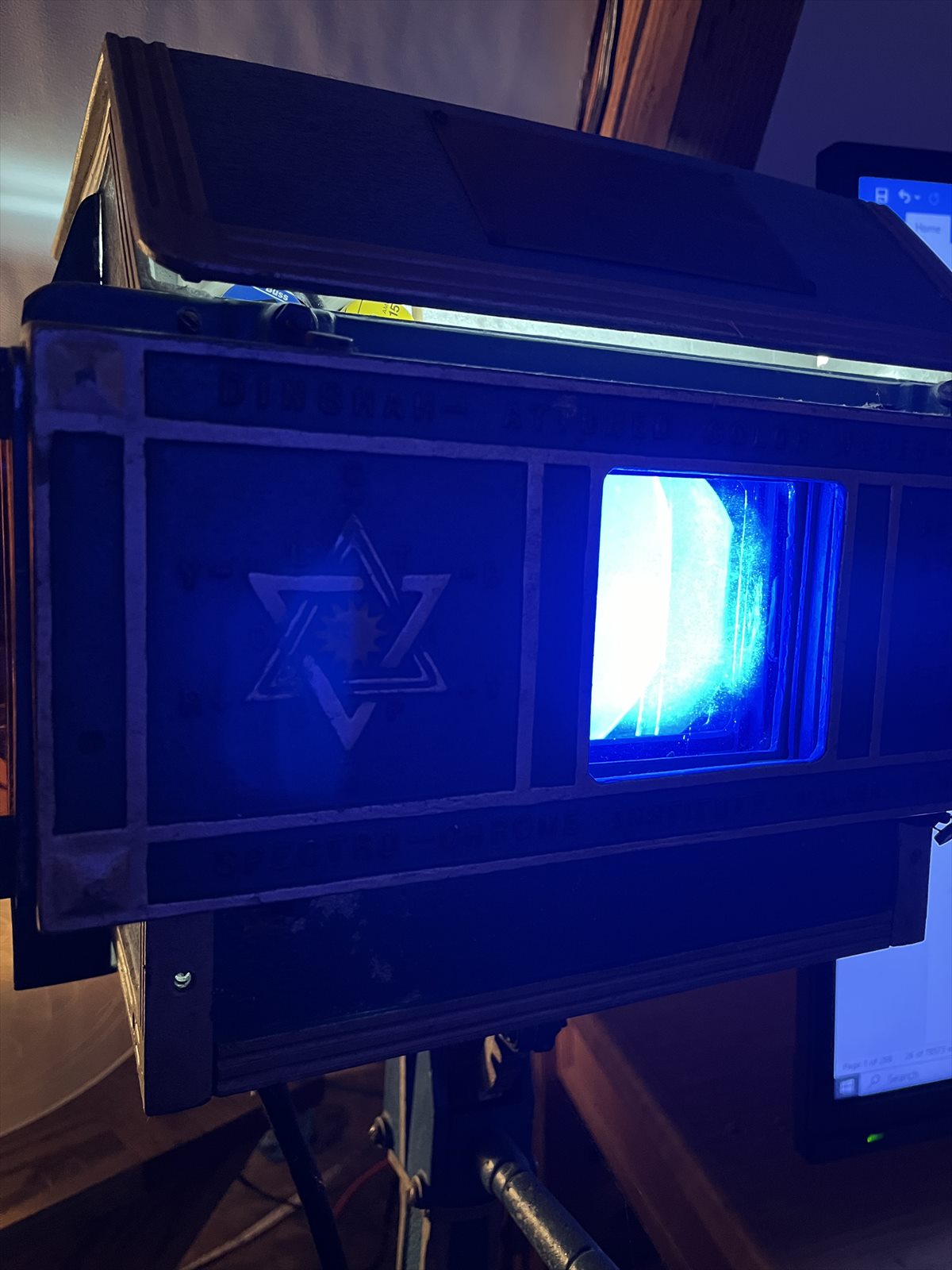
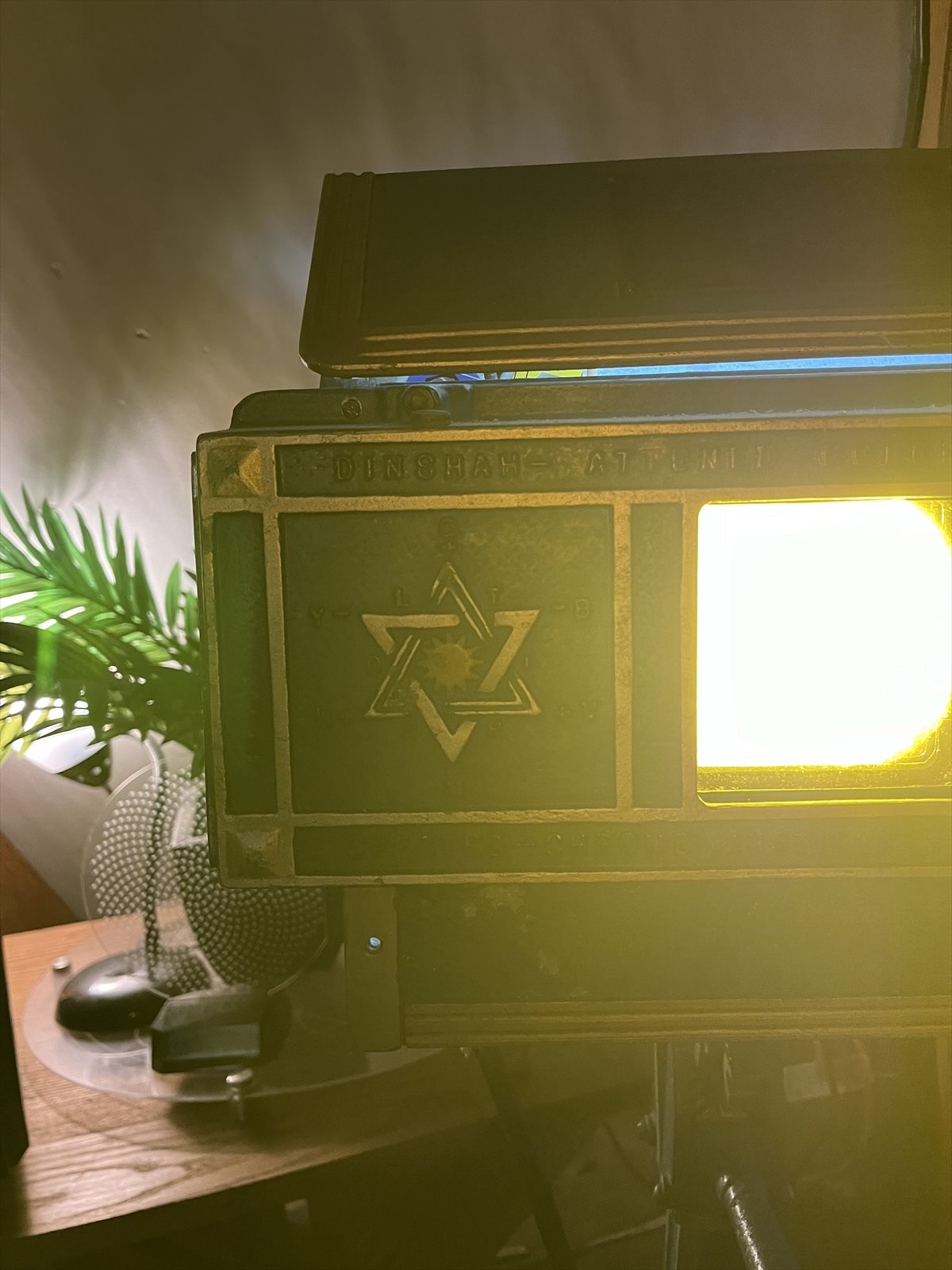
The plaque's "radio-active and radio-emanative equilibrium" names the balance Spectro-Chrome claimed to restore. In the Malaga Institute's tradition, the body was understood as both matter and radiance: Darius Dinshah's Let There Be Light describes an aura arising from cellular electrochemical activity, which selected colors were said to reinforce or quiet. This gives context to the inscription's language of emanation; the projector itself delivered filtered lamp light. Modern instruments do detect ultraweak photon emission from human skin, associated with metabolic chemistry and invisible to the unaided eye. These measurable emissions do not, by themselves, establish the aura or color-balancing mechanism proposed in the manual.
Contemporary photobiology investigates how light reaches receptors and changes biological activity. Retinal photoreceptors, including melanopsin-containing cells, help translate light into circadian timing. A small, unblinded study of green light for migraine reported fewer headache days, an encouraging but preliminary result. Red and near-infrared photobiomodulation is also being studied: a 2025 review covering 204 randomized trials found benefits for some outcomes, with evidence ranging from very low to moderate certainty. These findings concern particular exposures and conditions; they do not validate Spectro-Chrome's twelve-color prescriptions. The connection is the body's responsiveness to light. Understanding that response requires attention to wavelength, intensity, duration and the biological pathway involved.
Ghadiali produced twelve named illuminations from five matched glass filters. The nanometer figures below are approximate modern visual reference points already used in Temple of Light and Color—not measured peaks for the original broad-band filters. Purple, Magenta and Scarlet combine separated parts of the spectrum and therefore have no single wavelength.
Reported here as part of the Spectro-Chrome system’s internal classification.
A layered filter color rather than one narrow monochromatic beam.
One of the system’s five base matched filters.
The scale places Lemon between Yellow and its median Green.
Ghadiali’s framework positioned Green as the center between the Infra-Green and Ultra-Green families.
“Depressant” is the system’s historical polarity term, not a modern medical indication.
One of the system’s five base matched filters.
A layered filter color placed between Blue and Violet.
One of the system’s five base matched filters.
Extra-spectral: its appearance results from combined bands, not one spectral wavelength.
Extra-spectral: Magenta has no corresponding single band in a physical spectrum.
Extra-spectral: the historical apparatus combined two separated filter bands.
The device itself is almost austere: a thousand-watt lamp, a cooling fan, a water cell to drink the heat, condenser lenses, and five slides of colored glass — red, yellow, green, blue, violet. Singly and in pairs they sound twelve colors. The practice was as fixed as a liturgy: a one-hour tonation in a darkened room, light falling on bare skin, head to the north, the color and body area prescribed from numbered charts and timed to the sun. By 1933 the three-volume Spectro-Chrome Metry Encyclopaedia laid out the whole system — thirty-one axioms, twenty-two body areas, a color for every disorder.
Nearly 11,000 projectors sold by 1946; over $1,000,000 earned; five hundred machines a year; certification only after a 600-hour course. This was an institution with thousands of trained practitioners — not a mail-order trinket.
Practitioners ran clinics from Philadelphia to Los Angeles; the Institute at Malaga trained nurses, chiropractors, osteopaths and licensed physicians; the Spectro-Chrome Metry Encyclopaedia ran to three volumes and thirty-one axioms. Patients kept machines in their homes and tonated by the chart, nightly, for decades.
By the 1940s Spectro-Chrome was the largest single target in American drugless healing — which is precisely why the newly-armed Food and Drug Administration chose it first when the 1938 Act finally gave the government jurisdiction over medical devices.
Why I am the one telling you this
I own one of them.
As a kid I heard the family talk about “the box that made colors.” I never saw it — it was just one of those half-stories a childhood files away with the other mysteries. But something in me was already pointed at it. One Christmas I was given a colored disco ball, and I kept it up not for dancing — I wasn’t dancing — but purely for the look of the thing: one beam broken into a slow turning constellation of colored light on the walls. My grandfather kept a machine that turned light into color. I was the kid captivated by an instrument that spun color into pattern. The same inheritance, already turning, before I knew there was anything to inherit.
I’ve always been drawn to the occult, the esoteric, the metaphysical — so years later I finally asked about the box. It was sitting in a shed. The bulb had been swapped at some point in its long life, but the original colored slides were still there in their frames, the machine intact. I plugged it in. It worked — pouring light through glass exactly as it had in my grandfather Eugene Nagy’s day. It looked like precisely what it is: a relic of a suppressed science, or of a faith — and the difficulty of telling which is exactly why I kept pulling the thread.
Then the coincidences started. I went looking for anyone still making the colored glass slides, and found exactly one distributor left on earth — in Eugene, Oregon. My grandfather’s first name was Eugene. My family is from Manistique, Michigan, nicknamed the Emerald City — and so is Eugene, Oregon. Two Emerald Cities on opposite ends of the country, joined by a box of colored glass. And at the dead center of the Spectro-Chrome circle sits Green: the governing color, the equilibrator, where every single tonation is supposed to begin.
Make of that what you will. The system itself has a name for it — Babbitt called it the Harmony of Analogy: like resonating with like, “the unknown judged by the known, the invisible by the visible.” The synchronicities were the invitation. This project is the inquiry they warranted.
I brought the machine to my grandfather one last time, to a nursing home near the end of his life, and it turned into one of the last real conversations we ever had. His mind went straight to the fight the thing had always been part of. His verdict hadn’t softened an inch in seventy years, and he handed it to me like a password: “Down with the medical phonies.”
At the time I took it as an old man’s grudge. Then I read the history — and understood he had been handing me the short version of a war. To understand why this machine ended up in a shed instead of a hospital, you have to understand what was done to it, and to the people who staked their careers on it.
Kate W. Baldwin, M.D., F.A.C.S. — “The Therapeutic Value of Light and Color,” read before her state medical society, 1927
She was not a fringe practitioner. Forty-one years in practice; twenty-three of them senior surgeon at Woman’s Hospital of Philadelphia; a Fellow of the American College of Surgeons; credentialed in ophthalmology and otolaryngology. She ran eleven Spectro-Chrome machines every day inside the hospital and kept more in patients’ homes. And she published her cases, by name and detail, in the medical press of her day.
Her published list of responsive conditions was sweeping — and this is where a modern reader should feel the tension, because sweeping is what quackery also sounds like: cardiac lesions, asthma, hay fever, pneumonia, pleurisy, tuberculosis, corneal ulcers, glaucoma, cataracts, retinal hemorrhage, gastric ulcers, sinus infection, jaundice, kidney disease, mastoid disease, rheumatism, lumbago, sprains, bruises, abscesses, and “septic conditions, regardless of the specific organism.” She also claimed results in cancer and syphilis. She said she would give up medicine before she gave up color. Her colleagues petitioned to remove her from the surgical staff — and eventually succeeded.
Why her testimony still matters: she is the strongest evidence the movement ever produced and the clearest illustration of its limits. These are real clinical observations from a real surgeon, recorded with dates, distances and durations — the raw material of science. They are also uncontrolled, unblinded, unreplicated, and drawn from a physician who had already staked her identity on the outcome. What the era never did — what nobody was allowed to do after 1948 — was put the strongest of these claims through a controlled trial. The fire ended the argument without ever settling it.
To understand why a color lamp ended in a bonfire, you have to understand what was happening to American medicine in exactly those years. Before 1900 American healing was genuinely plural: allopaths competed with homeopaths, eclectics (Babbitt’s own tradition — his degree came from the Eclectic Medical College of Cincinnati), osteopaths, naturopaths, hydropaths and herbalists, each with their own colleges, journals, hospitals and state boards. Then came consolidation, and it was swift.
The critics of this consolidation were not a handful of cranks. Organized resistance appeared immediately: the National League for Medical Freedom was founded in 1910 — the very year of the Flexner Report — and the American Medical Liberty League followed in 1918, both fighting compulsory medicine and the licensing monopoly in statehouse after statehouse, with memberships in the tens of thousands. To them the pattern was plain: a guild had been granted the legal power to define what healing is, and was using it to eliminate everyone outside the guild. They called it the Medical Trust, deliberately borrowing the language of Standard Oil.
Both halves of that history are usually buried. Conventional accounts remember Flexner as the man who ended diploma mills — which he also genuinely did; standards before 1910 were often appalling, and reform saved lives. What goes unmentioned is that the same reform handed a single professional body, backed by two of the largest fortunes in history, the authority to erase every competing tradition of healing in the country — and that a large, organized public fought that erasure at the time and lost. Spectro-Chrome’s bonfire is a footnote of that larger war. An entire generation watched that consolidation unfold in real time.
The Camden courtroom was merciless, and honesty requires reporting it: a patient he claimed cured of seizures suffered one on the witness stand; a “cured” paralytic could not rise; a son testified that he shone yellow light on his comatose diabetic father, as instructed, and the man died. The defense answered with 112 satisfied users. Then came the fire — tons of books, magazines and case records incinerated by order of a United States court, the projectors broken up with them.
The countercurrent never accepted that ending. Medical-freedom leagues had been fighting compulsory medicine in the statehouses since the 1910s; a Buffalo jury had already sided with the healer over the professors; thousands who had taken the Malaga courses wrote testimonial letters by the sackful. To that public, 1948 was not science correcting error — it was a monopoly destroying a rival. And the Camden record genuinely cuts both ways: it documents real people steered from insulin toward colored light, and an erasure so total it forfeited any claim to mere error-correction. Skepticism of monopoly and fidelity to evidence are not opposites. That argument — who owns healing, and what proof it owes — is as alive today as it was in 1947.
The question outlived the bonfire: who gets to define illness, approve a treatment, fund the evidence, and decide what patients may hear? Regulators, manufacturers, insurers, professional bodies, medical journals, newsrooms, and digital platforms are separate institutions, yet their incentives can reinforce one another until the result feels like a single gate. That concentration of power deserves scrutiny even when no one is directing it from above. A medicine worthy of public trust must allow real competition among approaches, with open evidence, honest risk disclosure, and room for patients to choose.
Every one of those is a modern instance of the 1947 question: who owns healing, and what proof does it owe? Dinshah’s followers would have recognized the shape of it instantly. So would Kate Baldwin, pushed off a surgical staff for getting results her colleagues could not explain.
The pattern is larger than COVID or 1948. A system built around recurring treatment can be brilliant in an emergency and still neglect the conditions that make people sick in the first place. True medical plurality would give prevention, nutrition, environmental health, community care, and carefully tested non-patentable approaches a genuine chance to earn evidence and funding. It would support independent clinics and researchers, publish unfavorable results, compare outcomes openly, and let patients hear more than one informed view. Even the WHO calls for stronger primary care and prevention; those priorities should have real institutional power, not just a place in a policy statement.
And yet the lesson cuts both ways, which is precisely why this project argues for true medical plurality. A captured institution does not make its every critic correct — the same distrust that rightly questions a monopoly can be harvested by people selling something worse than what they’re attacking. Dinshah’s own record contains both real observation and real harm. The honest position is the harder one: the correct response to monopoly is not credulity, and the correct response to quackery is not burning books. It is open inquiry, published data, and the freedom to test a claim in daylight — the thing the fire of 1948 made impossible, and the thing a screen in every hand now makes possible again.
Darius Dinshah carried his father's Spectro-Chrome system into a compact manual—a book in which a family inheritance became a portable archive.
 View cover full size ↗
Practical Manual for Spectro-Chrome Therapy is the subtitle and the organizing intention: an accessible reference to the ideas, vocabulary, equipment and procedures associated with Dinshah P. Ghadiali's color-light system.
Darius was Ghadiali's son and the founder of the Dinshah Health Society. The Society describes his work as a sustained effort to preserve, organize and publish the movement's teachings. That makes this book a fitting companion to the surviving family instrument shown above: one preserves the apparatus; the other preserves a community's account of how it was meant to be understood. Author & Society ↗
Also listed by AromaTools; compare older editions through AbeBooks. Sellers set their own prices, availability and shipping. Links checked September 8, 2026.
The book moves between a language of color, the practical construction of light, an indexed catalogue of claims, and the testimony of the people who defended the method. These strands explain its role as both handbook and record of a movement.
Green occupies the middle of Dinshah's scheme. Warmer "infra-green" and cooler "ultra-green" colors form opposing families; purple, magenta and scarlet form a separate group. The teaching assigns meaning through these relationships, not through isolated swatches.
Color wheel · definitionsThe manual distinguishes printed color from radiant light and discusses lamps, filters and projector construction. The source's spectrum matters: a colored surface and a filtered beam are not interchangeable representations of the system.
Color production · projector plansA "tonation" is the book's term for an exposure session. Its method links color, body area, duration and timing. These are the author's prescribed historical practices, presented here for understanding rather than as treatment instructions.
Spectro-Chrome techniqueThe publisher describes 78 attributed color actions and 331 schedules associated with roughly 400 conditions. This turns the book into a cross-referenced lookup manual, joining named colors to a catalogue of claimed effects. Those counts describe the breadth of its claims; they do not establish that the schedules work.
Attributes · symptoms · condition indexChapters on musical equivalents and chemical elements extend the correspondence system beyond vision. They reveal an effort to connect light, vibration and matter within one explanatory order; their proposed associations should not be mistaken for demonstrated therapeutic equivalence.
Sound equivalents · colors for elementsThe World Research Foundation's description highlights reprinted articles and legal material alongside the practical sections. The book therefore preserves arguments, witnesses and the movement's own account of its struggle for acceptance. Read this material as documentary testimony, with attention to who is speaking and what the evidence can support.
Historical reports · legal recordThe thematic synopsis draws on the 12th-edition text (2016), the publisher's 13th-edition description, and the digital edition's catalogue record. Editions differ; the restored cover is not presented as the cover of the current edition.
Historian Matthew Lavine describes Spectro-Chrome as a participatory culture: users were encouraged to regard themselves as investigators, share observations, attend meetings and continue learning. Its appeal included the opportunity to take part in knowledge-making at a time when scientific medicine could seem remote and commercially organized. That context helps explain the importance of a book a family could keep, annotate and pass on. Lavine's historical study ↗
Our interpretation is that the manual's lasting cultural significance lies in this act of transmission. A machine may stop working; a vocabulary, diagram or written procedure can still provoke questions in another generation. Reading it carefully means taking that inheritance seriously while continuing to ask how its assertions would be tested.
Strip away the mysticism and something undeniable remains: light is a biological signal your body measures and responds to, down to the wavelength. Modern medicine already heals with color — it simply calls it phototherapy.
In 1903 Niels Finsen received the Nobel Prize in Medicine for curing lupus vulgaris with concentrated light of specific wavelengths — the first Nobel for phototherapy, awarded while Babbitt still lived. Light as medicine is not fringe; it is decorated, foundational science.
Clinical blue-light phototherapy is an established treatment for neonatal hyperbilirubinemia under medical supervision. Specific blue-green wavelengths convert bilirubin into forms the infant can excrete. That evidence is specific to neonatal phototherapy; it does not validate the broader therapeutic claims historically associated with Spectro-Chrome.
In 2002 science confirmed a third class of light receptor in the eye — melanopsin cells — that form no image at all. They read the color and intensity of light and set your circadian clock, hormones and mood by it. The body is, measurably, a light-tuned instrument.
UVB clears psoriasis; bright light lifts seasonal depression; red and near-infrared light are studied for healing and pain. The honest position is the one this project keeps: the historical therapeutic claims of Spectro-Chrome remain unproven, and nothing here is medical advice — but the deeper premise, that specific frequencies of light are read by human biology and change it, is no longer in dispute. That is the door the third century of light walks through.
The old instrument shaped a lamp through colored glass. This one shapes a display through finely controlled red, green and blue—bringing the exploration of color into your hand and your room.
A modern phone offers a vast palette of RGB combinations. A compatible Display P3 screen extends that palette into more saturated colors than standard sRGB can contain. The Universal Tuner detects the range reported by your browser and display, then lets you explore it with continuous hue, saturation and brightness controls, exact sRGB inputs, and the twelve colors of the historical circle.
The spectral mode adds a different way to navigate: a selected reference from 380 to 700 nanometers, adjustable in steps of 0.1 nm, with its calculated vacuum frequency. The visible field is an illustrative RGB interpretation of that reference. Screens and projectors mix their own primaries; a number on the tuner does not turn them into a tunable monochromatic light source. What they can do beautifully is carry a chosen color from a small display into an illuminated space.
Twelve named colors connect the live instrument to the archive. Spectral references and extra-spectral mixtures remain clearly distinguished.
Fine sliders, direct numeric entry, exact RGB and hex colors, and automatic Display P3 support on compatible devices. Tune a reference or mix a color entirely your own.
A uniform full-screen field with controls that disappear. Connect a compatible projector to cast it into the room, with optional slow breathing and screen wake-lock where supported.
A spectrum to explore. A color to make your own. Tune a spectral reference, mix freely across millions of RGB combinations, or let the field fill a screen and a room.
530.0 nm · spectral reference
The preview and projection use the same uniform color. Brightness adjusts the color signal; your device controls physical light output.
Fine steps of 0.1 nm. The field is an illustrative RGB approximation of this reference, not a measured emission wavelength.
Auto selects the color range reported by your browser and display.
A hex value opens Free color in sRGB so the entered color is preserved.
RGB entry uses 0–255 sRGB channels: 16,777,216 possible codes. P3 colors below are clipped to sRGB for this entry preview.
Fine numerical controls describe the chosen color signal. Display P3 extends the available gamut on compatible hardware; actual color, bit depth and brightness depend on the complete display path. Spectral readouts are references calculated with f = c / λ. Mixed colors—including purple, magenta and scarlet—have no single wavelength. This is a tool for color exploration and atmosphere, not a calibrated spectrometer.
Babbitt asked his century to “study the Light; attempt the high.” Ours has the instruments to actually try.
Beyond flat fields: tonation through structure — phyllotaxis vortices on the golden angle, interference between calibrated spectra, sacred-geometry lattices and rosettes projected as shaped light, marrying the color calibrations to the geometry that has always traveled beside them.
Light that listens: sessions that adapt to breath and heart rhythm, and — as consumer neurotech matures — an open research question of what patterned, attuned light and the nervous system have to say to one another.
The historical claims kept as history; the real photobiology — circadian light, phototherapy, the measurable power of the spectrum — pursued as science. This project keeps both lamps lit, and never confuses the two.