Documented history
A claim anchored to an identifiable letter, minute book, object, publication or institutional record.
A sub-exhibit of New Atlantis · Washington · Franklin · The Craft
George Washington, Benjamin Franklin & the Craft of a Republic
A surveyor who learned the world by chain and right angle, and a printer who drew fire out of a thundercloud. Both were Freemasons, both were builders of institutions, and both left warnings to the people who would inherit what they built.
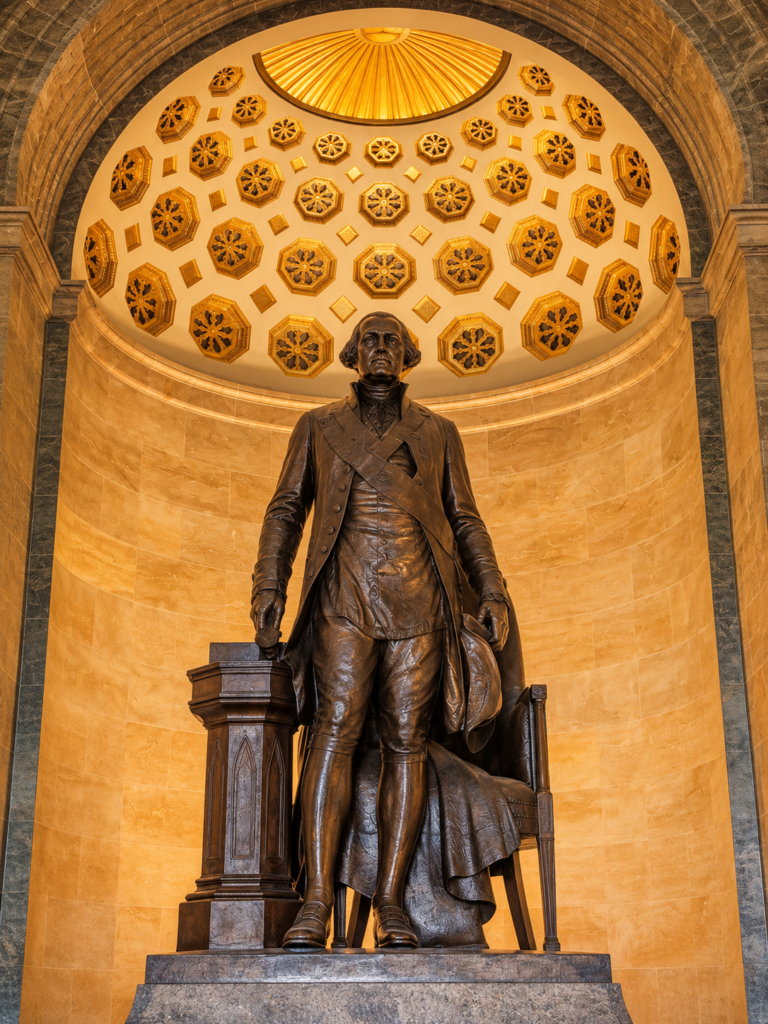 Plate I · Bryant Baker’s Washington in Memorial Hall, Alexandria
The questionWhat kind of mind builds a republic?
Neither man was trained for the part history handed him. Washington left formal schooling early and learned his first trade with chain, compass and field book. Franklin walked out of his brother’s print shop at seventeen and taught himself languages, natural philosophy and the arts of persuasion.
What they shared was a habit of measurement: of land and weather, of character, and of the forces that move people and things. New Atlantis follows the reform of knowledge from Bacon’s Salomon’s House to the American founding. This study narrows the lens to two of its builders, both of them members of the fraternity whose lodges taught morality in the language of the square, the level and the compasses. [01]
Franklin became a Fellow of the Royal Society, the institution that grew out of Bacon’s dream of organized inquiry. Washington surveyed land as a young man, then as a farmer kept records, tried new crops and designed a sixteen-sided barn. Both served in the lodge, and Washington, late in life, rejected the charge that American lodges were vehicles of conspiracy. And both left warnings about how a free people loses its freedom. [14][02][21]
As in the parent exhibition, each connection here carries its evidence: documented history, scholarly interpretation, symbolic reading, or an unverified claim held open as a question.
A claim anchored to an identifiable letter, minute book, object, publication or institutional record.
An argument about what the evidence means, attributed to its historian or institution.
A thematic connection drawn by this exhibition, with its interpretive character stated plainly.
A proposed connection whose evidence has not been established. It stays a question.
Drag through the century. Franklin was born in 1706 and Washington in 1732. Their lives overlapped for fifty-eight years and crossed at several documented points.
Franklin’s account of the kite appears in the Pennsylvania Gazette on October 19; his lightning-rod instructions follow in Poor Richard for 1753.
On November 4 he receives the first degree, Entered Apprentice, in the lodge at Fredericksburg, Virginia, paying two pounds and three shillings.
Ages are counted from birthdays: Franklin, 17 January 1706; Washington, 22 February 1732. Each card shows the most recent documented episode at or before the chosen year. [01][30][08]
The synoptic mind · Thirteen workbenches
Synoptic means seeing together. For both men one field kept opening into the next. Franklin’s press led to the post office, and the post office led him to the ocean. Washington’s surveyor’s chain led to farms, mills and, in the end, the site of a capital on the Potomac.
Neither worked alone. Franklin had collaborators and correspondents across two continents. Washington’s mill, barn and distillery were built and worked largely by enslaved people. Select a field; the ones they shared are marked “Both.”
Franklin worked out from the eclipse storm of November 1743 that northeast storms travel up the coast from the southwest, against their own winds. Washington kept weather notes in his diaries for half a century; his last entry, on 13 December 1799, the day before he died, records snow and wind.
[48][49]The craft taught its members to revere geometry. Select a station to follow how measured knowledge actually travelled, and how the masons told that story themselves. Dashed stations record legend, not history.
Babylonian scribes calculate in a place-value system based on sixty. Our sixty minutes and three hundred and sixty degrees descend from their arithmetic and astronomy.
Read the source ↗Baghdad’s Greco-Arabic translation movement flourished in the ninth and tenth centuries, when Greek, Persian and Indian works were rendered into Arabic and extended by scholars such as al-Khwarizmi. The twelfth century is when much of that learning crossed into Latin, above all through translators working in Toledo. Historians still debate the size and exact role of the institution called the House of Wisdom; the translation movement itself is not in doubt. [32]
The Renaissance, the Reformation and the scientific revolution grew in soil that had been turned many times. A Latin West that once received Euclid through Arabic hands later produced Bacon, Newton and the Royal Society. That is a chain of readers, translators, schools and printers, and each link can be dated.
The oldest surviving masons’ charge, the Regius poem of about 1390, opens with a legend: Euclid founded the craft as geometry in Egypt, and it spread from land to land until it reached England. Later Old Charges lengthen the story, and Anderson’s Constitutions of 1723 carry it into the printed age, the same book Franklin reprinted in 1734. [31][04]
The legend is itself a document, but a document of how the craft imagined its ancestry, not proof of an unbroken lodge from Egypt to London. Read that way, it is remarkably close to the real route: geometry did travel from the Nile and the Euphrates, through Alexandria and Baghdad, into Latin Europe. The masons kept the itinerary and filled in the travellers.
The transmission is documented as a public chain of manuscripts, translations, universities, presses and societies, each with names and dates. A single hidden program steering it across four thousand years would need records of contact, instruction and coordinated action between those links. No such chain is presented in this exhibition. The question remains open, and it should be pursued the way Bacon recommended: by evidence that could, in principle, prove it wrong.
The questionWhat did a lodge offer a young tradesman with no family name?
At twenty-five, Franklin was a printer with a newspaper, a reading club and debts to pay. In February 1730/31 he entered St. John’s Lodge, which met in a Philadelphia tavern, and within three years he was presiding over the Masons of Pennsylvania.
He helped draft the lodge’s by-laws in 1732 and served as a grand warden that summer. On June 24, 1734 he was elected Grand Master, and the same year he reprinted James Anderson’s Constitutions of the Free-Masons from his own press, the first Masonic book printed in America. From 1735 to 1738 he kept the lodge’s books as its secretary. [04][05]
The lodge was one of a dozen associations Franklin built or joined: the Junto, the Library Company, the Union Fire Company, the American Philosophical Society, the Academy that became the University of Pennsylvania. Each turned private improvement into public capacity. Read beside them, his Freemasonry looks less like a secret and more like a habit: gather capable people, write rules, keep accounts, elect officers, and repeat.
In Paris the habit became diplomacy. In 1778 Franklin joined the Loge des Neuf Sœurs, the Lodge of the Nine Sisters, a gathering of savants, writers and artists. On April 7 of that year Voltaire was initiated there, and Franklin took part in the ceremony. In 1779 Franklin was elected the lodge’s Venerable, its presiding master, and was re-elected in 1780. [34][07]
Initiated in St. John’s Lodge, a tavern lodge, around February 1730/31. A ledger in his own hand records his account with the lodge from 1734 to 1737. [05]
Elected Grand Master of Pennsylvania on St. John the Baptist’s Day. His reprint of Anderson’s Constitutions carries the craft’s rules, charges and legendary history across the Atlantic. [04]
The lodge founded in 1776 by the astronomer Lalande gathers scientists, artists and men of letters. Its tokens of 1778 carry the Masonic date 5778. [34]
Franklin presides as Venerable. That year he presents a copy of Houdon’s celebrated bust of himself to the lodge, of which Houdon has just become a member. [06]
Masonic documents of the period date events Anno Lucis, “in the Year of Light,” by adding four thousand to the common year: 1734 becomes 5734 and 1778 becomes 5778.
Historians of the Nine Sisters have described it as a kind of international academy of the arts and sciences, and Franklin’s years as its Venerable coincide with his campaign to win and keep French support for the American cause. The fraternity offered a network of sympathetic, influential people; it did not give orders to the French crown, and membership alone does not show that the lodge directed any political act. [34][01]
The questionHow often was the most famous Mason of his age actually in a lodge?
Washington received all three degrees within ten months, between November 1752 and August 1753, at Fredericksburg. The lodge’s minute book then records him there only twice more.
His Masonic life after that was ceremonial rather than routine: festivals of St. John with military lodges during the war, honorary membership in Alexandria, the charter of Alexandria Lodge No. 22, letters to Grand Lodges, and in 1793 the laying of the Capitol’s cornerstone with Masonic ritual. [01]
In 1798 a Maryland minister, G. W. Snyder, sent him John Robison’s Proofs of a Conspiracy, which alleged that the Bavarian Illuminati were corrupting lodges. Washington replied that he presided over none and had not been in a lodge “more than once or twice, within the last thirty years.” [02]
In a second letter that October he allowed that the doctrines attributed to the Illuminati, and the principles of Jacobinism, had spread in the United States, while maintaining that he did not believe American lodges had, as societies, set out to propagate them. The parent exhibition follows the actual Illuminati in Chapter VI ↗.
November 4, at twenty. The fee: two pounds, three shillings.
Passed March 3, raised August 4. The minute book later records only two attendances, on September 1, 1753 and January 4, 1755.
June 24, with a military lodge of Connecticut officers and enlisted men.
An honorary member since 1784, he agrees to serve as charter master when the lodge moves from Pennsylvania’s Grand Lodge to Virginia’s.
April 30, New York. No Bible had been arranged; the altar Bible of St. John’s Lodge No. 1 was fetched, and Chancellor Robert R. Livingston, Grand Master of New York, administered the oath.
September 18. As grand master pro tem, he presides over the Masonic ceremony laying the cornerstone of the United States Capitol.
Alexandria Lodge commissions William Williams to paint Washington wearing his Masonic apron and jewel.
September 25 and October 24. He denies presiding over any lodge and defends the lodges, as societies, against the charge of spreading Illuminati principles.
December 18. Brothers of Alexandria Lodge perform Masonic rites at his funeral. The lodge is soon renamed Alexandria-Washington Lodge No. 22.
The George Washington Masonic National Memorial is dedicated at Alexandria in 1932. In 1950 President Truman unveils Bryant Baker’s bronze in Memorial Hall, the statue on this study’s cover.
Dates from Mark A. Tabbert’s account for Mount Vernon, the Snyder correspondence and St. John’s Lodge’s record of its Bible. [01][02][03][33]
Euclid I.47 · The surveyor’s right angle
In 1749, at seventeen, Washington was commissioned surveyor of Culpeper County. Surveying is applied geometry: closing a boundary depends on laying out true angles and measuring true distances. The forty-seventh proposition of Euclid’s first book, the theorem of the right triangle, is the surveyor’s oldest friend.
The same proposition became an emblem in the lodge. In American Masonic teaching the “forty-seventh problem of Euclid” appears among the emblems of the Master Mason degree and on the jewel of a Past Master, a reminder to love the arts and sciences. Build a triangle below and watch the squares balance. Symbolic reading · Institutional tradition
3² + 4² = 9 + 16 = 25 = 5²
The square on the hypotenuse holds exactly as much as the other two together.
Whole-number triple · 3 · 4 · 5A cord knotted into twelve equal spaces and pegged at 3, 4 and 5 makes a right angle without any instrument. Whether Egyptian rope-stretchers used it this way is debated; the arithmetic is not.
The claim that L’Enfant’s avenues trace a square and compasses, a pentagram or an owl is widespread. The plan does contain diagonals radiating from public squares, as Baroque city plans commonly do. A deliberate Masonic design would require evidence from the planners themselves: drawings, letters or instructions that say so. That evidence has not been presented here, and Washington’s documented Masonic act in the city is the ceremonial laying of the Capitol cornerstone. [01]
The questionHow did Washington’s brothers choose to remember him, and how did the sculptor who studied his face?

Memorial Hall · George Washington Masonic National Memorial
On Shooter’s Hill above Alexandria, the Freemasons of the United States raised a memorial to their most famous brother.
Ground was broken on June 5, 1922, and the building was dedicated in 1932. Its architect, Harvey Wiley Corbett, sketched it as a colossal “lighthouse of Freemasonry,” drawing on the Pharos of Alexandria, one of the Seven Wonders of the ancient world. [39][40]
Visitors enter Memorial Hall through a temple portico. Eight green granite columns forty feet high line the hall, with murals by Allyn Cox. At the far end, in an arched apse, stands Bryant Baker’s bronze Washington: seventeen feet three inches tall, delivered in eight pieces, and dedicated by President Harry S. Truman, himself a Mason, on February 22, 1950. [11][37]
“makes even more impressive the entrance hall of this temple”Harry S. Truman · dedication address · 22 February 1950
Baker, himself a brother of the craft, shows Washington in Masonic regalia, apron and sash, as the Master of his lodge. Seventy-five years to the day after Truman’s dedication, on February 22, 2025, the statue was rededicated. [11][41]
Above the statue the apse rises into a half-dome of gilded octagonal coffers, each holding a rosette, set between smaller diamond coffers and crowned by a gilded fan. Plate II on the cover redraws that geometry from photographs; it is an interpretive drawing, not a measured survey.
Baker’s statue is a twentieth-century act of remembrance by the fraternity: Washington as presiding Master, dignified in regalia. The eighteenth-century record in Chapter IV is quieter. Washington agreed to be charter master of Alexandria Lodge No. 22, yet in 1798 he wrote that he had been in a lodge only once or twice in thirty years. Both are true. One shows how the brotherhood honours him; the other, how often he attended. [01][02]
Beside Memorial Hall, the Replica Lodge Room reproduces the room on the second floor of Alexandria’s City Hall where Alexandria-Washington Lodge No. 22 met for more than 140 years, beginning in 1802. [11]
Richmond, 1796 · The statue taken from life
The questionWhat did Houdon choose to put in Washington’s hands?
In 1784 Virginia’s General Assembly voted a statue of Washington “of the finest marble and the best workmanship.” In Paris, Jefferson and Franklin found the sculptor: Jean-Antoine Houdon, who five years earlier had joined the lodge Franklin led. [09][06]
Houdon insisted on working from life. In July 1785 he crossed the Atlantic on the ship carrying Franklin home, and on the night of October 2 he arrived at Mount Vernon with three assistants. For two weeks he measured Washington’s body and took a plaster life mask of his face. [08]
He carved the figure in Paris from Carrara marble and signed it with the date 1788. It was placed in the Capitol at Richmond on May 14, 1796, where it still stands at the centre of the rotunda, lit from above. [09]
Jefferson designed the Capitol as a temple in the Roman manner. The rotunda’s dome, about thirty feet across, was inserted by its builder with an oculus beneath a skylight, and it is completely hidden from outside: a dome you cannot see from the street. [10]
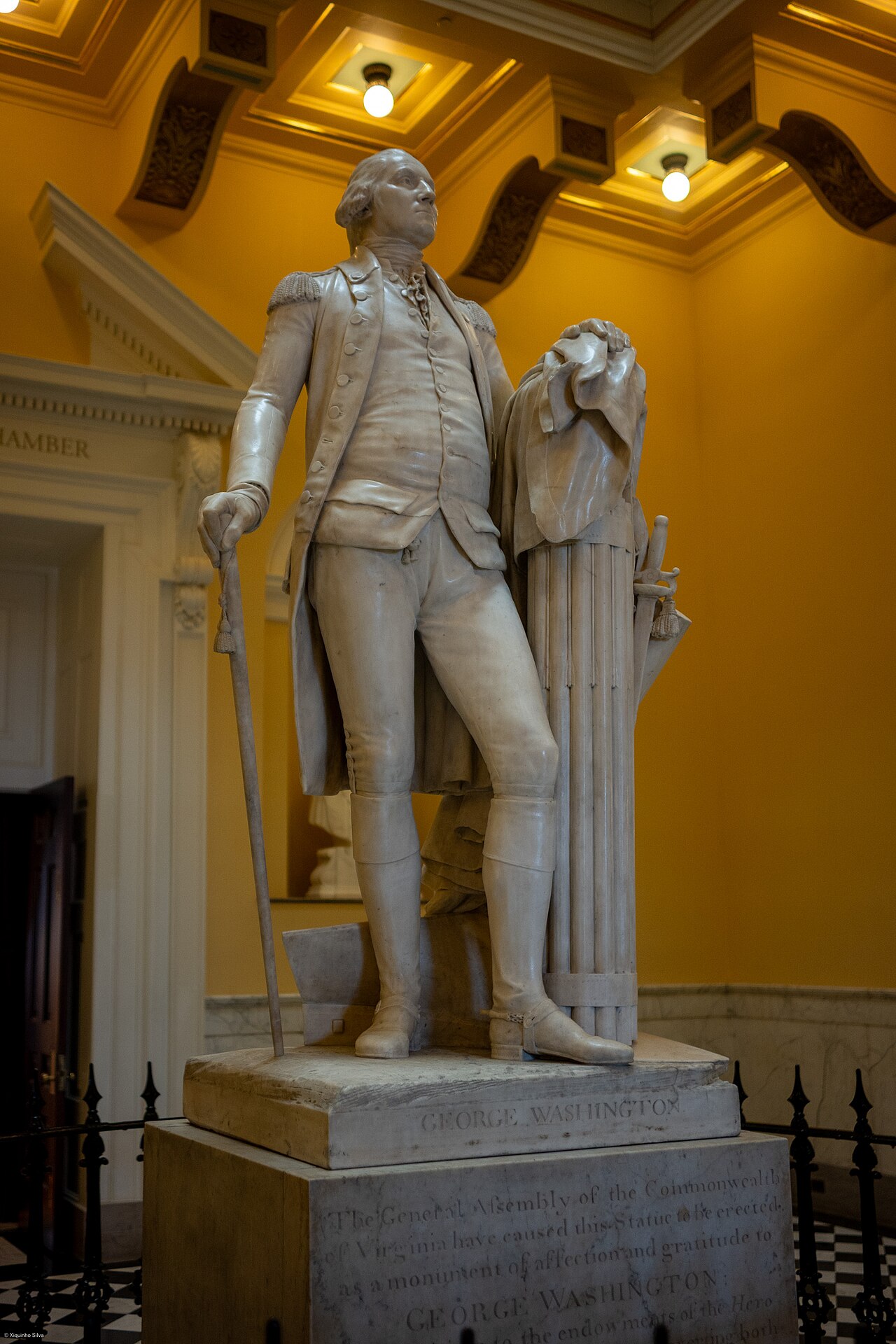
Houdon’s plaster life mask of 1785, and the clay bust he modelled at Mount Vernon, are the basis of the face. Washington kept the bust in his study; many contemporaries thought it the truest likeness ever made of him.
Consult the record ↗Photograph: xiquinhosilva, CC BY 4.0, via Wikimedia Commons. Numbered markers follow the statue’s parts as they appear in this view. [09]
Its vocabulary is Roman and civic, not Masonic: the fasces of magistracy, a sword set aside, a plow. The Masonic connection lies in the people who made it happen. Franklin, the Venerable of the Nine Sisters, helped choose the sculptor; Houdon, a member of that lodge, made it; and the man it portrays was a Mason. Calling the figure itself a Masonic emblem would go beyond the evidence. [06][09]
Alexandria. Bryant Baker’s seventeen-foot bronze in Masonic regalia, the statue on this study’s cover, stands in the apse of Memorial Hall at the George Washington Masonic National Memorial. [11]
Richmond. Houdon’s marble original stands beneath the hidden dome of the Virginia State Capitol, the statue read part by part above.
Washington, D.C. A bronze copy of Houdon’s figure, given by Virginia, stands in the Rotunda of the United States Capitol, beneath Brumidi’s Apotheosis of Washington. Another bronze cast of it stood in an alcove of the Washington Monument’s lobby until 2025, when it was moved to the White House Rose Garden. [12][42]
From the street, the Capitol at Richmond is a temple front and a gabled roof. Inside, light falls through a concealed dome onto a man resting his hand on the emblem of power while his sword hangs unused. This exhibition reads that architecture as an image of its theme: the deeper workings of a republic are not hidden by conspiracy but placed inside, where citizens have to walk in to see them. The builder’s choice, not a documented intention, is the factual basis of that reading. [10]
The questionIs lightning the same fire that leaps from a charged jar?
Franklin’s letters on electricity, read in London by his friend Peter Collinson, proposed a test: raise a pointed rod into a storm cloud and see whether it draws off electric fire.
In May 1752 Thomas-François Dalibard performed the rod experiment at Marly, near Paris, and it worked. Franklin’s own version with a kite, which Joseph Priestley later dated to June 1752, appeared as a brief account in the Pennsylvania Gazette on October 19, 1752, with instructions for repeating it. It was read to the Royal Society that December. [13][36]
The Royal Society awarded him the Copley Medal in 1753 and elected him a Fellow in 1756, an honour very few colonists received. Bacon had imagined a House of Salomon; a Philadelphia printer now sat among the Fellows of its real successor. [14]
The same fire killed Georg Wilhelm Richmann in St. Petersburg in August 1753, while he was attempting a similar experiment. The kite was not a parlour trick. [36]
Following the 1752 accountThe kite is up and the storm is coming on. The twine is hemp; the ribbon in the hand is silk and must stay dry, so the experimenter stands in a doorway out of the rain.
An interpretive simulation of the sequence Franklin described, not a physical model. Do not attempt it: Richmann died repeating a lightning experiment.
Franklin’s Gazette notice gives instructions, not a dated narrative, and names no witnesses; the date and the detail of William’s help come from Priestley’s history fifteen years later, presumably from Franklin himself. Most historians accept that the experiment took place. A minority, notably Tom Tucker in Bolt of Fate (2003), has argued that the account was a deliberate fiction. The French rod experiment, by contrast, was witnessed and published at once. [13][36]
Number at play · A letter to Peter Collinson
As a young clerk of the Pennsylvania Assembly, bored by the debates, Franklin amused himself by making magic squares. He sent this one to Collinson, describing its “curious properties.” Every row and column sums to 260 and every half to 130, but his favourites were the bent rows: chevrons of eight cells that also make 260, even when they wrap across the edge of the square. [15]
Choose a pattern
Each pattern lights its cells and adds them as you watch.
Honest arithmetic: the two main diagonals sum to 228 and 292, so by the modern definition this is not a perfect magic square. Franklin built something else, a square whose order lives in its chevrons.
1761 · The armonica
After hearing tuned drinking glasses played in London, Franklin mounted glass hemispheres on a single iron spindle turned by a treadle, so that a player’s wet fingers could sound chords. He named it the armonica, in honour of the Italian language, and described it in a 1762 letter to the physicist Giambatista Beccaria. Mozart and Beethoven later wrote for it. [16]
Franklin painted the glasses so a player could find the notes: C red, D orange, E yellow, F green, G blue, A indigo, B purple, and the semitones white. The rims below follow his colours. Touch or sweep across them to play; each glass rings with a slow, bell-like swell.
Sound begins when you first touch a glass. Franklin’s instrument had thirty-seven glasses across three octaves; this one has fifteen.
The questionWhat does a republic owe to the soil?
Washington wrote of agriculture as the pursuit he loved best. He gave up tobacco for wheat, rotated crops, tested fertilizers and seeds, and kept records with a surveyor’s exactness.
Hemp was one of his working crops. Mount Vernon grew it throughout his life for industrial use: rope and sail canvas, thread for sewing sacks, and repairs to the seine nets at the estate’s fisheries. In recent years Mount Vernon has planted an industrial hemp cultivar again to interpret that history. [17]
In February 1794, writing from Philadelphia as president, he told his farm manager William Pearce what to do with seed that had been saved:
“Make the most you can of both, by sowing them again in drills.”Washington to William Pearce · 24 February 1794 · on St. Foin and India hemp seed
That August he asked again that the India hemp seed be saved “in due season.” The popular slogan that he told Americans to sow hemp everywhere compresses these practical farm letters. [18]
Washington’s letters treat it as a promising seed to propagate and evaluate. Mount Vernon interprets his hemp as a fibre crop, and nothing in his papers shows that he used it as a drug. Which variety he had is uncertain. For a contemporary charter that returns to hemp, local cultivation and public water, see the parent exhibition’s 21st-Century Bill of Rights ↗. [17][18]
1792 · Dogue Run Farm · Washington’s own design
Threshing wheat on open ground left grain in the dirt and at the mercy of the weather. In October 1792 Washington sent his manager a plan for something new: a two-storey barn of sixteen sides around an octagonal core. Horses walked a circular track on the upper floor; the floor was laid with gaps so the trodden grain fell through to the granary below, out of the rain. [20][19]
The barn was built between 1792 and 1794 by skilled enslaved workers, and reconstructed at Mount Vernon in 1996 from his drawings. It measured about fifty-two feet across, with sixteen walls each about ten feet three inches long. Change the number of sides below to see the compromise he chose: nearly a circle for the horses, yet straight walls a carpenter could frame. [19]
The questionIf Washington walked into the present, which of his tests would he apply first?
No one can say what Washington or Franklin would think today. What we can do is read the tests they wrote down and apply them ourselves.
On the last day of the Constitutional Convention, September 17, 1787, Franklin asked his colleague James Wilson to read a speech for him. He accepted the Constitution “with all its faults,” and predicted it would be well administered for a course of years, yet “can only end in Despotism, as other forms have done before it, when the people shall become so corrupted as to need despotic Government.” [22]
James McHenry, a Maryland delegate, jotted down an exchange outside the hall. Elizabeth Willing Powel of Philadelphia asked what they had made, a republic or a monarchy. “A republic,” Franklin answered, “if you can keep it.” McHenry’s journal is the only source for the remark. [23]
Nine years later, declining a third term, Washington published his Farewell Address. It is a manual of the ways republics fail. Select a warning to read his words beside a question for the present.
“The alternate domination of one faction over another … is itself a frightful despotism.”
Party spirit, Washington argued, inflames jealousies, opens the door to foreign influence, and tempts the public to seek security in the absolute power of one man.
Which of my political loyalties would survive if my own side held power with no one to check it?
Documented history · Measure the present
Washington joined two warnings that are often quoted separately: cherish public credit and avoid the accumulation of debt, and stay alert to the “insidious wiles of foreign influence.” He also asked his successors not to throw upon posterity “the burden which we ourselves ought to bear.” [21]
The figures below are the Treasury’s own. They change daily, so each carries its date; follow the sources for the current reading. Whether they amount to the danger he described is a judgment for each reader to make with the evidence in view. [24][25][43]
About $40.55 trillion on 4 November 2026, from Treasury data. It first passed $40 trillion in August 2026.
The portion borrowed in markets from domestic and foreign lenders: about $32.77 trillion on 4 November 2026.
Treasury International Capital data for August 2026, about $9.33 trillion. Japan, the United Kingdom and China hold the most.
About $9.33 trillion (August) against roughly $32.3 trillion held by the public in late August 2026. The rest, roughly seven dollars in ten, is owed at home.
TIC data assign holdings by where securities are held in custody, so country figures are approximate; Treasury itself cautions against precise conclusions by country. [25]
Established: Hamilton’s national bank, chartered for twenty years. Washington signed the bill after asking his cabinet whether it was constitutional; Jefferson and Randolph argued it was not.
Scope: the founders themselves divided over concentrated finance. Washington’s decision is part of this record too.
Argued: rechartering the Second Bank would hand a bounty to a few, noting that “more than a fourth part of the stock is held by foreigners.”
Scope: an early American argument about foreign ownership of a national financial institution, made a generation after Washington. [26]
The critics’ account. The twelve regional Reserve Banks are organized like private corporations; their stock is held by member commercial banks, which elect six of the nine directors of each Reserve Bank. Critics argue that this gives private banking an outsized voice in public money and that the system answers too little to elected officials.
The Federal Reserve’s account. The Board of Governors is an independent federal agency. Reserve Bank stock cannot be sold or traded and carries none of the control of ordinary shares, and by law no foreign financial institution may own it. On that account, the system is “not ‘owned’ by anyone.” [35]
Foreign holders of Treasury securities are lenders to the government, not shareholders in the central bank. Whether a creditor’s weight becomes the “foreign influence” Washington feared is the live question; the two should not be confused.
The questionWhat did the builders leave undone, and who had to finish it?
The republic these men built rested in part on the labour of people it held in bondage.
In 1799, 317 enslaved men, women and children lived on Mount Vernon’s five farms. Washington owned 123 of them outright, and in his will he ordered that they be freed after his wife’s death; Martha Washington freed them on January 1, 1801. The others, held by the Custis estate, remained enslaved. He was the only founder to provide for a large-scale manumission in his will. [27]
Franklin had owned enslaved people and his Gazette printed advertisements for their sale. In old age he changed course. In 1787 he became president of the Pennsylvania Society for Promoting the Abolition of Slavery, and on February 3, 1790 he signed its petition asking the First Congress to “devise means for removing the Inconsistency from the Character of the American People.” Congress declined to act. Franklin died ten weeks later. [28]
The parent exhibition takes up the wider struggle over who the word universal included in Chapter VIII ↗.
“My fine crab-tree walking stick, with a gold head curiously wrought in the form of the cap of liberty, I give to my friend, and the friend of mankind, General Washington. If it were a sceptre, he has merited it, and would become it.”
The stick, a gift to Franklin from the Comtesse de Forbach in Paris, reached Washington in May 1790. It is now in the Smithsonian. In Richmond, Houdon’s Washington also holds a cane while his sword hangs unused on the fasces: the citizen’s staff in hand, the soldier’s weapon laid aside. [29]
On the convention’s last day Franklin looked at the sun painted on the back of the President’s chair, where Washington had sat all summer, and said he now had “the happiness to know that it is a rising and not a setting Sun.” [22]
The craft builds with square and level.
A republic builds with consent—
and every generation must build it again.
Washington and Franklin did not hand down a finished building. They left tools, a set of plans with errors in them, and warnings about how such buildings fall. The square still tests the angle. The kite still tests the sky. Whether the republic holds is a test that can only be passed by the people living in it now.
The 1723 Constitutions, the three degrees, and the difference between association and direction.
A sub-exhibitNew JerusalemNumber, measure and the cosmos: the measured city and the Earth–Moon model.
A sub-exhibitA 21st-Century Bill of RightsTwelve proposed articles, a hemp-paper folio and a public ledger of restoration.
Lodge records, letters, institutional histories, Treasury data and attributed interpretation behind this sub-exhibit.
Washington’s degrees, attendances, lodges, the Capitol cornerstone, the Williams portrait and his Masonic funeral; the fraternity’s neutrality during the Revolution.
Robison’s Proofs of a Conspiracy and Washington’s answers on the lodges and the Illuminati.
Washington’s letters to and from lodges, including press copies of the Snyder letters.
Franklin as warden in 1732 and Grand Master in 1734; his reprint of Anderson’s Constitutions.
The St. John’s Lodge ledger in Franklin’s hand and the printing of the “Mason Book.”
Franklin as Venerable of the Nine Sisters in 1779, when Houdon was a newly elected member.
The secretary of the Loge des Neuf Sœurs writes to Franklin; contemporary comment on his lodge activities.
Houdon’s arrival on 2 October 1785, his two weeks at Mount Vernon, the life mask and the clay bust.
The 1784 commission, the statue’s placement on 14 May 1796, and its uniform, sword, fasces, plow and cane.
Jefferson’s design and the rotunda dome concealed from the exterior.
Memorial Hall’s columns and murals, Brother Bryant Baker’s statue dedicated by President Truman in 1950, and the Replica Lodge Room.
Virginia’s copy of Houdon’s Washington in the Capitol Rotunda, dated 1934.
Franklin’s instructions, the reading at the Royal Society, and the lightning-rod directions in Poor Richard.
The Copley Medal of 1753 and William Franklin’s part in the experiment.
The square of 260 and its bent rows, as Franklin described them.
The 1761 instrument, its thirty-seven glasses and colour-coded rims.
Washington’s industrial hemp, its uses on the estate, and its return to the farm site.
St. Foin and India hemp seed, “sowing them again in drills.” See also his letter of 17 August 1794.
Design in 1792, construction by enslaved workers 1792–94, dimensions, and the 1996 reconstruction.
The enclosure sent to Anthony Whitting with the sketch and list of materials.
Faction, foreign influence, alliances, public credit, military establishments, usurpation, morality and knowledge.
Franklin’s closing speech as read by Wilson, and the rising sun on the President’s chair.
McHenry’s note of Franklin’s answer to Elizabeth Powel.
Total public debt outstanding, debt held by the public and intragovernmental holdings.
Foreign holdings by country of custody, with Treasury’s caution on interpreting them.
The argument against rechartering, including foreign ownership of the Bank’s stock.
The 317 enslaved people at Mount Vernon in 1799 and the manumission of the 123 Washington owned.
Franklin’s presidency of the Pennsylvania Society from 1787 and the petition of 3 February 1790.
The codicil’s words and the delivery of the stick by Major Clarkson.
Franklin, Lynch and Harrison confer with the commander in chief on the Continental Army.
The Regius and Cooke manuscripts and the legendary history of the craft.
The Abbasid royal library, the translation of Greek works under al-Ma’mun, and the limits of what is known about it.
St. John’s Lodge No. 1’s altar Bible and the 1789 oath.
Lalande’s lodge, its savants, and Franklin as Venerable 1779–81.
Member-bank stock, its limits, and the prohibition on foreign ownership.
Dalibard at Marly in May 1752, Priestley’s dating, and Richmann’s death in 1753.
The statue’s height, its delivery in eight pieces, and Truman’s 1950 dedication address.
The dedication of Bryant Baker’s statue in Memorial Hall.
Corbett’s “lighthouse of Freemasonry,” the 1922 groundbreaking and the 1932 dedication.
Corbett’s inspiration in the Pharos of Alexandria.
The rededication of Baker’s statue on 22 February 2025.
The 1992 bronze cast of Houdon’s figure moved from the Washington Monument lobby.
Gross national debt, debt held by the public and intragovernmental debt, with the date of each reading.
Franklin and Timothy Folger’s chart of 1768 and its later versions, including the 1786 edition.
Franklin’s pamphlet describing his fireplace, with the editors’ note on its design.
“Happy in the invention of double spectacles.” His fuller description followed on 23 May 1785.
Franklin’s essay on colonial population growth, with the editors’ note on its influence on Malthus.
Franklin, the eclipse storm of 1743 and the direction in which northeast storms travel.
Daily diaries of weather, work and events, from his first surveying trip in 1748 to 13 December 1799.
The elevation drawing in Washington’s hand, his pattern books, the piazza and the cupola.
The Spanish jack sent by Charles III and the start of mule breeding at Mount Vernon.
Oliver Evans’s patent of 18 December 1790 and the Evans system Washington installed in 1791.
Begun in 1797; five copper stills; nearly 11,000 gallons in 1799.
Shares bequeathed to Liberty Hall Academy and toward a national university in the District of Columbia.
Franklin’s plan for what became the American Philosophical Society.
Plate I: Photograph by Nagy Design, 2026. The statue is Bryant Baker’s George Washington (1950), George Washington Masonic National Memorial, Alexandria, Virginia.
Chapter V, dedication: President Truman speaking at the George Washington Masonic National Memorial, 22 February 1950, Abbie Rowe, National Archives and Records Administration, public domain.
Chapter V: Virginia State Capitol, xiquinhosilva, 2025, CC BY 4.0, via Wikimedia Commons. Houdon’s statue itself (1785–1796) is in the public domain.
Original illustrations: Plate II (the apse half-dome of Memorial Hall), Plate III (the kite in the storm), the Euclid figure and the barn plan are original interpretive drawings made for Infinity Envisioned in 2026. They are not measured surveys or archival evidence.
Editorial approach: Chapter questions and propositions are curatorial interpretations. Treasury figures are dated and rounded; follow the linked datasets for current values. Institutional accounts of Freemasonry and of the Federal Reserve are identified as such.
