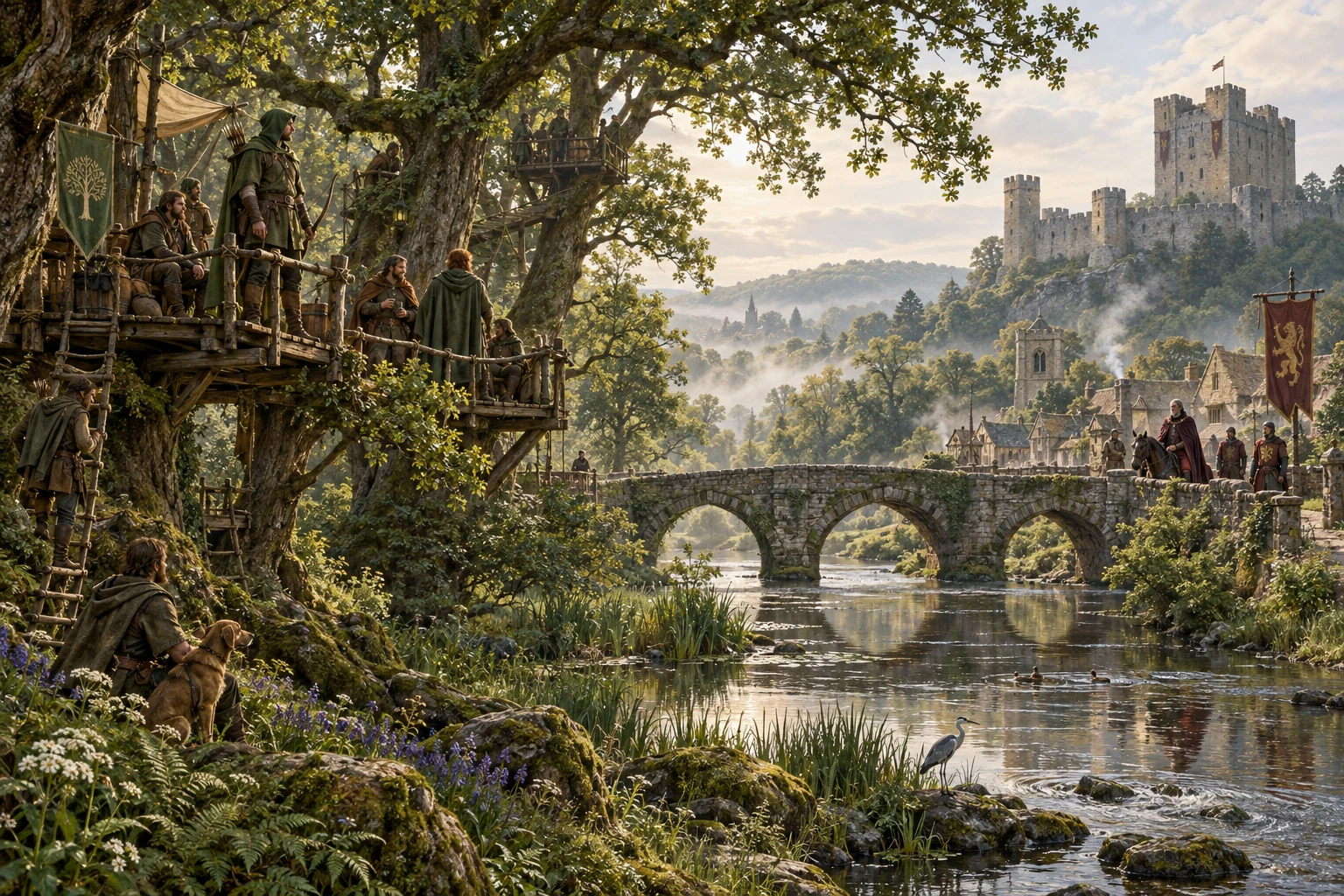
A settlement held in common, run at the efficiency of a forest.
Speculative exhibition · Measuring public will · The ledger is kept by the land
THE COMMONS · THE RIVER KEEPS THE BORDER · THE ENCLOSURE
DESCEND ▾
"Robyn was a prode outlaw, Whyles he walked on grounde: So curteyse an outlawe as he was one Was never non yfounde."
— A GEST OF ROBYN HODE · FIRST FYTTE · c. 1500
IThe Legend Is a Land Claim
Before it was a story, Sherwood was a jurisdiction.
The Greenwood & the CrownAI-generated interpretation of the legend
After the Conquest of 1066, England's new kings threw a legal net over living country and called it Forest. Afforestation did not mean planting trees. It meant that the deer, the timber, the honey, the pasture — the whole working metabolism of a landscape people had lived inside for centuries — now answered to the Crown. At its height, Forest Law covered something like a third of England. Taking "venison and vert," the king's deer and the green that fed them, could cost a commoner his freedom, and in the harshest tellings, his hand or his eyes.
The ballads grew up in that shadow. The first surviving mention of the outlaw is a throwaway line in Piers Plowman, around 1377 — a lazy priest admits he can't recite his prayers but knows his "rymes of Robyn Hood" by heart. By the time the long Gest of Robyn Hode was printed around 1500, the shape was set: a free man of the greenwood at war with two institutions. The sheriff — enforcement. And the abbot — finance.
That second enemy is the one we forget. In the Gest, the pivotal act isn't an ambush. It's a loan. A knight is about to lose his land to the Abbot of St Mary's over a £400 debt, and Robin covers it — interest-free, secured on nothing but Our Lady's good name. The oldest Robin Hood story in existence is about a community treasury outcompeting a predatory lender.
The redistribution came later. The original grievance was older and sharper: the commons had been enclosed, and the greenwood remembered.
Then, in 1217, something remarkable: alongside the reissue of Magna Carta, the Crown was forced to seal the Charter of the Forest — a companion document restoring the rights of ordinary people to the woods. Pannage, the right to run pigs on acorns. Estover, the right to gather wood. Turbary, the right to cut turf for the fire. Even the honey found in one's own trees. No man was to lose life or limb for the king's deer. It stayed on the statute books for 754 years — one of the longest-standing laws England ever wrote — and it is, essentially, the founding document of commons rights in the English-speaking world.
This exhibition proposes taking the legend at its word. Not the pantomime — the claim underneath it: that a landscape can be held in common, defended in common, and made to prosper in common. And that the way you beat the abbot is not with arrows. It's with a better treasury.
HONEST NOTE — The legend is a palimpsest. "Rob the rich, give to the poor" is largely a later accretion; the medieval core is outlawry, forest law, and hostility to sheriff and moneylender. We use the myth as myth — a memory of the commons — not as history.
IIEnclosure Never Ended
What the fence began, the ledger finished.
Drag the years and watch it happen. First the king's net. Then, from the 1600s to the early 1900s, more than five thousand Acts of Parliament fenced roughly a fifth of England — the open fields and common wastes that had fed the landless — and converted commoners into wage-labor. The fence then went abstract: mineral rights severed from surface rights, water rights traded like grain, the acre financialized into an instrument that performs for people who will never stand on it.
10662026
The wood is held in many hands — pannage, estover, turbary: the grammar of common right.
And the present tense of that history sits on Lake Superior's south shore. Fourteen miles north of Wakefield, Michigan, hard against the Porcupine Mountains Wilderness — the largest tract of old-growth hardwood left between the Adirondacks and the Rockies — a Canadian junior called Highland Copper holds a fully permitted project named Copperwood: an underground mine designed to grind some 6,800 tonnes of rock a day and ship roughly sixty-five million pounds of copper a year for an initial eleven, with early site works complete and a construction decision approaching behind an updated feasibility study due in early 2027. Twenty-one local governments have passed resolutions in favor. Conservation groups have fought it for a decade. Both are telling the truth about their situation — and that is precisely the trap.
This exhibition does not claim Copperwood will poison the lake. It claims something quieter and harder to dismiss: a region rich in water, forest, and skill keeps reaching for the drill because nobody has built it a better offer. The mine is not the villain of this story. It is the symptom — the syllable the old system keeps repeating. Sherwood is the counter-offer, sketched in public.
II · FIELD NOTEWho Owns the Clearing?
The enclosure is also a balance sheet.
A country can become richer while security remains out of reach for many of the people who keep it running. The question is who owns the homes, businesses, land, and financial assets that appreciate — and who must meet each new bill with the next hour of work. Sherwood begins here: how can a community build prosperity that its members can actually share?
Wealth means assets minus debts: a stock of ownership and financial security. Income is the flow received over time. The groups below are ranked by net wealth. "Middle 40%" means the 50th–90th wealth percentiles; it is not a definition of the income-based middle class.
SHARE OF NET WEALTH
United States · 2026 Q2
Households ranked by wealth
0%25%50%75%100%
Top 1%99th–100th percentiles
32.5%
Next 9%90th–99th percentiles
36.4%
Middle 40%50th–90th percentiles
28.8%
Bottom 50%Lowest half by wealth
2.3%
Every quarter · drag or use arrow keys
The top 1% own about 14.1 times the combined wealth of the bottom half.
Federal Reserve, Distributional Financial Accounts · 2026 Q2 · released September 18, 2026. Bars use a common 0–100% scale. Values are rounded.
What has changed?
In the United States, the top 1% held 22.8% of household wealth in 1989 Q3 and 32.5% in 2026 Q2: a rise of 9.7 percentage points. The middle 40% moved from 35.7% to 28.8%; the bottom half from 3.5% to 2.3%. Today, the top 1% hold slightly more than the bottom 90% combined. These are shares of total wealth, not claims that one group owns another group's property. [1]
Worldwide, the World Inequality Report 2026 estimates that in 2025 the top 1% owned 37% of personal wealth. The top 10%, including that 1%, owned 75%; the middle 40% owned about 23%; the bottom half just 2%. At the very summit, the top 0.001% — roughly 56,000 adults — increased their share from almost 4% in 1995 to over 6% in 2025. [2]
The record includes recoveries as well as concentration. The U.S. bottom half's share has recovered from 0.4% in late 2010. Globally, the bottom half's inflation-adjusted wealth has grown since 1995, even as enormous absolute gaps persist and the fortunes at the very top grow faster. A smaller share does not by itself mean falling purchasing power; a rising balance does not by itself mean secure housing, affordable care, or control over one's time. U.S. household estimates and global adult estimates use different methods and should be read on their own terms. [1][2]
When the shortfall compounds.
In the Federal Reserve's 2025 household survey, 28% of adults struggled to pay bills in the previous month, and 26% went without some medical care during the year because of cost. Among those struggling with bills, 12% increased income through steps such as overtime or an extra job. Work and insecurity can occupy the same household. [3]
01A bill arrives
A repair, a rent increase, or a medical expense meets a thin reserve.
02The cost spreads
A late fee, interest, or delayed treatment can enlarge the original problem.
03Time is consumed
Extra shifts and administrative work leave less room for recovery, care, or learning.
04The buffer shrinks
The next disruption arrives before the household has rebuilt its margin.
This is the lens of structural violence, developed by Johan Galtung: avoidable harm embedded in arrangements that distribute resources, power, and life chances unequally. Harm can accumulate through ordinary rules and institutions without a single person delivering a blow. The term asks us to examine the conditions that keep reproducing deprivation. [4]
"Poverty is the worst form of violence."
Gandhi's character in Gandhi (1982), played by Ben Kingsley. [5]
Better tools, information, and products can ease parts of daily life. Sherwood asks a further question: do those gains also buy people stability, time, and a meaningful say in the systems they depend on? Convenience alone cannot settle the distribution of land, essential services, or the surplus produced by a community.
A community should be able to keep its gains.
Sherwood's proposal is to broaden ownership, hold essential land in trust, reinvest a share of surplus locally, and make the rules visible and contestable. Shared infrastructure, cooperative enterprise, and reserves for difficult years are ways to test that proposal. Wider public systems still matter: healthcare, social insurance, fair taxation, housing, and labor protections operate at scales a settlement cannot replace.
No arrangement will meet every need or settle every disagreement. A credible experiment must show whether essentials become easier to afford, whether people gain time and reserves, whether ecological damage falls, and whether power remains accountable. Rebalancing wealth is a design problem that has to be measured in lived security.
How do we persist without tearing each other apart — and build a prosperity that leaves room for one another?
Sources, dates & definitions
Federal Reserve — Distributional Financial Accounts.Wealth shares by household wealth percentile, 1989 Q3–2026 Q2; release September 18, 2026. Top 1% combines the top 0.1% and next 0.9%; values rounded to one decimal. Historical estimates can be revised. Percentage-point changes compare shares, not inflation-adjusted dollar gains.
World Inequality Lab — World Inequality Report 2026.Chapter 1 and executive summary: global personal net wealth estimates for adults, 2025, and trends since 1995. Global figures are rounded; next 9% and middle 40% are derived from the reported group shares.
Federal Reserve — Economic Well-Being of U.S. Households in 2025.Economic Hardships, May 2026. Percentages use different reference periods and the extra-work figure refers only to adults struggling with bills. The four-step sequence above illustrates possible mechanisms; it is not a measured pathway for every household.
Johan Galtung (1969)."Violence, Peace, and Peace Research,"Journal of Peace Research 6(3), 167–191. Structural violence is an analytical framework, distinct from a statistical measure of inequality.
Quote attribution. The sentence is spoken in Gandhi (1982), screenplay by John Briley. It is widely attributed to Mahatma Gandhi; an original speech or writing has not been verified here.
Sources checked September 23, 2026. The measurements above document the problem; the community proposals express this exhibition's perspective.
IIIThe Water Ledger
There is a rate at which taking becomes breaking. Hydrology is the audit.
A forest is not scenery standing on top of a water system. A forest is a water system — canopy intercepting rain and slowing it to a soak, roots and fungal thread holding the soil open like a sponge, transpiration lifting moisture back into the air to fall again downwind. Around forty percent of the rain that lands on continents was last evaporated from land, not sea: forests upstream are, quite literally, part of the rainfall infrastructure of forests downstream. Strip the sponge — pave it, compact it, pile it into tailings — and the same rain arrives as a different event. It runs instead of soaking. The flood and the drought are the same wound, expressed in different weather.
Let it rain on two lands and watch the ledger settle.
Same storm. Two fates.
Forested watershed
Stripped watershed
Press the button. The forest banks the storm; the stripped land converts it into a flood, then a drought.
This is the actual argument against extraction-without-limit, and it needs no conspiracy to work. Every economy sits inside a hydrological budget. Exceed the rate at which the land can circulate water — by removing the vegetation that runs the cycle, sealing the soil that stores it, or drawing down what took centuries to bank — and the bill arrives as flood damage, crop failure, fire weather, and, eventually, as the oldest political story there is: whoever controls the scarce water controls everyone who needs it. Scarcity is the enclosure that enforces itself. A civilization that wants to stay free has a direct, unsentimental interest in keeping water abundant — which means keeping the living systems that make it abundant intact.
HONEST NOTE — Continental moisture recycling (~40% of land rainfall re-evaporated from land) is well-established science. The stronger "biotic pump" hypothesis — that forests actively drive coastal winds inland — remains contested. Greenhouse warming, not land use alone, is the dominant driver of today's hydrological extremes. The claim here is about rates and resilience, not a single cause.
IVThe Sherwood Principle
Steal like a forest.
Robin's genius was never the theft. It was the overhead. A band in the greenwood ran on almost nothing — no keep to garrison, no court to feed, no ledger of rents to enforce — and so every ounce it intercepted became use, not upkeep. That is a forest's trick too. An engine is called efficient when it minimizes loss on the way to its exhaust. A forest has no exhaust. Leaf-fall is soil; soil is root; the death of one thing is the operating budget of the next. Nothing in the greenwood is wealthy, and nothing is wasted.
Modern settlements are built the other way: as throughput machines. Water in a pipe, once, to the sea. Nutrients in a truck, once, to a landfill. Heat made deliberately and thrown away deliberately. The financing demands it — extraction pays on volume moved, not on value circulated. Sherwood inverts the constraint. Its founding rule is that the settlement must run, as nearly as engineering allows, the way its watershed runs: on loops, on gradients, on slow circulation — taking from the flow, never from the stock.
Water before roads.The watershed is the first infrastructure. Every surface — roof, lane, field — is designed as a catchment that feeds the soil, before it is designed as anything else.
The canopy is a utility.Shade, rain-making, timber, food, medicine, and quiet — maintained, metered, and expanded like one. The settlement's tree cover only ratchets upward.
Nothing leaves as waste.Every material output must be some process's input, or it doesn't get built. Nutrients, greywater, heat, and timber cascade until they're soil again.
Power moves like sap, not like blast.Energy is gathered slowly and stored in gravity, warmth, and living tissue — sun, small water, coppice — sized to the place instead of the place resized to it.
A full third stays wild.The Norman kings afforested a third of England for the king's deer. Sherwood returns the gesture: one third of its land unmanaged, in perpetuity, answering to no one.
HONEST NOTE — This exhibition stands in a lineage that includes Viktor Schauberger's "implosive" reading of natural motion — centripetal, cooling, condensing, against the explosive and heat-shedding. We use it here as a generative metaphor and a design compass, not as settled physics. The engineering beneath these laws — swales, constructed wetlands, cascading reuse, district heat — is conventional and proven.
VThe Settlement
Sherwood is not sited in wilderness. It is sited on the wound.
The program, held speculatively: a settlement of roughly four thousand people on about two thousand acres of cutover — the stump-lands, worked-out pits, and compacted ground the last extraction economy left behind. Not pristine land; repaired land. The founding act is hydrological, not architectural: re-open the soil, daylight the buried streams, plant the sponge. The buildings come after the water, and no building rises above the canopy it stands in. Touch the districts to read the plan.
THE PLAN
Touch a district
Seven grounds, one watershed. Each district is sized to what the land beneath it can circulate — and every one of them reports, ultimately, to the river.
Speculative plan. The Meander — a daylighted stream — is the settlement's spine; its flood meadows are public ground by law.
The hemp acre. Longacre's anchor cash crop is the one the greenwood grew for war and rigging before Robin ever drew a bow — and the one his bowstring was most likely spun from. Hemp. In 1533 Henry VIII made growing it compulsory — a quarter-acre for every sixty under the plough — because a navy runs on cordage and cordage ran on hemp; the word canvas is cannabis worn smooth in sailors' mouths. Sherwood plants it for the old reasons and the new ones at once. The stalk splits into two crops: long bast fiber for cloth, cord, and the Mycelium's looms; woody hurd for hempcrete — hemp and lime cast into walls that insulate, breathe, and bank carbon as the lime slowly turns back to stone. The seed is a third crop, food-grade protein and oil. A plant where every fraction has a buyer is Design Law III made agricultural: nothing leaves as waste.
It earns its ground before it earns a penny. A hundred-day canopy dense enough to shade out weeds without herbicide; a taproot that breaks compacted soil; a documented appetite for drawing metals out of damaged ground — which matters when your charter reads sited on the wound. On cutover and mine-scarred land, hemp is the first succession you can invoice. The honest catch is the one the last boom forgot: the money is not in the field, it is in the mill. Retting, decortication, and pressing are where the margin lives, and the recent bust broke farmers who grew for processors that never got built. So the Moot owns the decorticator the way Rochdale owned the store: the crop is a commons only if the machine is.
HONEST NOTE — Hemp here means low-THC industrial cultivar, federally legal in the U.S. since 2018 with licensing still required; nothing medicinal or psychoactive is claimed. Its water thrift is moderate, not miraculous. Phytoremediation is real but slow, and on genuinely contaminated ground it turns the harvest into a disposal question — on merely tired land, it is a soil-builder. The processing bottleneck is the industry's documented weak joint, which is exactly why the design hands the mill to the commons.
The long orchard. Around the hemp acre, Longacre's frame is agroforestry — not fields with trees at the edge, but a forest that happens to yield. Nut and timber rows run the contours; annual crop lanes alley between them; pigs and fowl work the understory in fenced rotations; mushrooms fruit on the shade side of the log-lines. Three root depths share the same rain, the canopy is a utility exactly as the fourth chapter ordered, and the wind arrives at the lettuce already tired. The lineage is older than the jargon: J. Russell Smith called it tree crops — a permanent agriculture in 1929, and it was his phrase, compressed, that later gave permaculture its name.
The buried rain. The cutover's debris — slash, stumps, storm-fall — is not burned. It is buried, in long ridges: hugelkultur, hill culture, the old German trick of building a bed on a core of rotting wood. Decaying logs hold water like a cellar full of sponges; fungal threads run the log-lines like roads; the slow rot feeds roots for a decade and gently warms the bed in its first springs. It is the Water Ledger buried in a garden: the storm is banked beneath the mulch and spent through the drought. Press the years below and watch the wood become ground.
Year one. Slash and stump from the clearing, buried instead of burned. The wood begins to drink; nitrogen is tied up while the rot sets in — the bed's one hungry year.
The pattern library. Call the whole approach what it is: regenerative practice under a permaculture design grammar — soil covered, living roots year-round, steel kept out of the ground, diversity as policy, animals in the loop, zones of intensity radiating from the door. Look back at the map and you will find Sherwood re-derived the zone diagram without meaning to: kitchen gardens at the Hearth, Longacre beyond, coppice past that, and the Wild Third standing exactly where Zone Five belongs — the part you design by leaving alone. Mollison and Holmgren wrote the grammar down in 1978; Shepard proved the broadacre case on worn-out Wisconsin sand. Sherwood treats it all as a pattern library, not scripture.
HONEST NOTE — These are practice traditions more than settled literatures. Hugelkultur is largely practitioner-documented, and its first year ties up nitrogen while the rot establishes. Regenerative agriculture's definitions vary and its carbon-sequestration magnitudes are genuinely debated. Permaculture is a design philosophy whose claims sometimes outrun its trials. The mechanisms drawn above — buried-wood water retention, fungal transport, multi-storey root partitioning — are real; the yields promised by enthusiasts are not guaranteed.
VIThe Moot
No sheriff. A steward.
"The commons ends in tragedy" was always a half-truth told about a fiction — an open pasture with no community around it. Where real commons fail is where the community that governed them has been broken. Elinor Ostrom spent a career documenting the opposite: forests, fisheries, and irrigation systems run in common for centuries, sometimes millennia, by ordinary people with the standing to make and enforce their own rules. She won the Nobel for it in 2009. Her findings are the closest thing Sherwood has to a constitution, and they translate into the greenwood almost without effort:
iThe bounds are walked. Everyone knows exactly what is held in common, and who holds it.
iiRules fit the ground. Water rules written by this watershed, not imported from a capital.
iiiThose who follow the rules write the rules. The Moot — the whole settlement in assembly — amends its own law.
ivThe watchers answer to the watched. Monitors of soil, water, and forest are commoners, accountable to the Moot.
vSanctions climb slowly. A first breach earns a word, not a ruin. Punishment is graduated, and public.
viQuarrels are settled cheaply and near. Conflict resolution at the Moot Ring, in days, not in distant courts, in years.
viiThe right to organize is not begged for. Outside authority recognizes the settlement's rules as rules.
viiiCommons nest. The household inside the district, the district inside the watershed — decisions made at the smallest scale that can hold them.
The land itself is taken off the market on day one: held by a community land trust, so that no acre of Sherwood can ever again become an instrument that performs for someone who will never stand on it. Homes are owned; ground is stewarded. Decentralization here isn't an aesthetic or a retreat — it's the load-bearing structure. Small communities federated across watersheds are hard to capture, hard to hoard, and — as automation absorbs more of the old economy's labor — increasingly the natural scale at which people can govern the systems they actually depend on: their water, their soil, their food, their power.
VIIThe Health Dividend
The body keeps the settlement's books.
The claim is not mystical. Controlled trials of time spent walking in forest against time walking in city streets consistently measure lower cortisol, lower blood pressure, and lower sympathetic arousal in the forest condition. Large cohort studies keep finding that people who live amid more greenery die later of most things — an association, layered with confounders, but one that refuses to go away across countries and decades. And a newer line of research suggests the biodiversity around a body helps train the immune system that defends it. None of this is a miracle. All of it points the same direction: an environment built like a living system charges the humans in it; an environment built like a machine for yield extracts from them, gently, all day.
Which brings us to what modern building has actually become. Walk through what's gone up in the last few decades and you can read the financing in the massing — floorplates shaped by yield curves, cladding chosen by spreadsheet, the value engineered out of exactly the places a human eye rests. Christopher Alexander spent his life showing the alternative: that towns and buildings assembled from patterns of lived life — the courtyard, the window seat, the street café, the sheltering roof — produce places people measurably love and defend for centuries. Sherwood's design code is a pattern language, not a style guide. Its architecture answers to the nervous systems of the people who live there, because that — not the exit valuation — is what a settlement is for.
HONEST NOTE — Forest-medicine trials are real but small; NK-cell findings are preliminary; greenspace-mortality links are associations, not proven causation. We claim a strong tailwind, not a cure. The health dividend is a reason to build this way — it is not a promise of outcomes.
VIIIThe Ledger of Return
Money is a verb here.
Double-entry bookkeeping was Venice's quiet superweapon: a ledger that could remember, forever, exactly who owed whom. Its blind spot is what it cannot see. A yield ledger has one plot — value enters, value is owed back at interest, value exits — and every column in the book serves the exit. That, properly, is throughput: not our word but the existing economy's true name — a linear machine that value passes through on its way out, entering a place as investment and leaving it as yield and waste. Sherwood keeps the other book. Call it a ledger of return, kept the way nature keeps it: the initial investment enters once — count it in dollars or hundredweights of oak, the arithmetic doesn't care — and it never exits. It is translated, around a wheel: coin into timber and stone; stone into standing shelter; shelter into taught skill; skill into energy that flows for decades from a flume built once; energy into food that recurs every autumn without being bought again; food into health; health into trust — and trust back into coin's real work, which is coordinating the next translation. The investor's return is not denominated in yield. It is denominated in standing.
The trick that lets a closed loop argue with entropy is hiding in plain sight: know-how is the one asset that doubles when you spend it. Teach the timber frame and there are two framers; the pool paid once and holds the skill twice. Places have run this book before. In 1932 the Austrian town of Wörgl issued local scrip that lost a little value each month unless spent — so it moved, hand to hand, many times faster than the schilling; public works were built and the town's unemployment fell against the national tide, until the central bank sued the experiment out of existence. The sheriff rides in; he always does. And Herman Daly, who gave throughput its meaning in economics, supplies the correction Sherwood adopts whole: it is the physical flow — ore, fuel, timber — that must be kept slow and small, and the coin that should run fast. Keep the money quick and the logs slow. Below: the same hundred units, kept twice — once by the Lord's throughput book, once by ours. One reading note before you pull the lever: in the return book the pool barely falls even as standing wealth climbs, and that is not a bug — translation is turnover, not spending. The same coin frames a roof, then pays a teacher, then buys seed, and comes home to the pool each time; what accumulates is everything it touched. Watch the velocity line. Money is a verb here, and the ledger counts its conjugations.
SEASON 0
Same seed, two books. The Lord's Ledger is throughput itself — value passing through the town on its way offsite. The Ledger of Return translates coin into things that do not leave.
100
In circulation
0
Standing wealth
0
Extracted offsite
0
Lost to entropy
HONEST NOTE — The machine above is illustrative arithmetic with fixed toy rates: a rhetorical instrument, not an economic model. Wörgl (1932–33) is documented, including its shutdown. Local-multiplier measurements are real but methodologically debated. Daly's "throughput" is used in its proper, unflattering sense — it names the economy we already have. And the hardest problem is left standing on purpose: conventional capital wants an exit, and a ledger of return only offers an entrance. Which is precisely why the next chapter counts many small hands instead of courting one vault.
IXThe Greenwood Tally
Capital gets a harvest, not a throne.
For six centuries England's Treasury ran on split hazel. A debt was notched across a stick and the stick was cleft down its length: the creditor kept the longer half — the stock, which is where that word in finance comes from — and the Exchequer kept the foil. To redeem, the halves were matched; wood grain being unrepeatable, the tally was effectively unforgeable. It was a treasury instrument made of forest, and it worked from the twelfth century until 1826. When the government finally burned its obsolete tally hoard in 1834, the stove flues overheated and the fire took the Houses of Parliament with it — the old ledger's one good joke. Sherwood revives the instrument. Pledge below and the exhibition mints you a tally: you hold the stock — a code to save and redeem later — and the muster roll holds only the foil, a fingerprint that can match your half but never reproduce it.
And here is what the tally would mature into if Sherwood were ever built — a bridge between the throughput economy and the ledger of return, written so both sides win:
I.Conversion is consensual. Nothing converts until the assurance threshold is met and you personally confirm, raise, or withdraw. Then a pledge becomes a Greenwood Tally.
II.The Commons Dividend. Each year, a fixed share — say a fifth — of the settlement's measured surplus is distributed pro-rata to tallies: energy beyond need, food beyond the hall, fiber beyond the mill, water banked beyond the budget, skills taught beyond the walls. Surplus is read aloud at the Moot from the Ledger of Return, the same night as the water budget. Your yield is indexed to the ecobalance: the only way to be paid is for the place to be alive.
III.From the flow, never the stock. No surplus, no dividend — a deficit year pays nothing and owes nothing after. Principal is never "repaid," because the principal is the town. The investor is paid the way a forest pays: out of growth, or not at all.
IV.The cap and the retirement. Lifetime return is capped — call it 1.6× — and a filled tally retires into standing: lodging-rights, a named beam in the Hearth, an honored voice, a place at the table. Capital is a guest here: welcomed, fed well, thanked, and not enthroned. No perpetual claim survives.
V.Contribution mints at par. Hours, craft, taught skill, an accepted design — the Ledger of Return already records them, and they mint the identical instrument. The knight's £400 and the miller's son's strong back muster the same. This is the door for those rich in ideas and thin in coin: merit and money hold the same paper.
VI.No throne. Tallies carry no vote on land or law. The trust holds the land off the market; the Moot is one voice each, tally or no tally. The abbot may buy a share of the harvest. He may not buy the moot.
Why would old money come at all? Because the yield is real, bounded, and uncorrelated with the extraction cycle — a claim on a living system's surplus instead of a dying system's principal — plus the option value of a proven pattern. And why does it align? Because under Article II the investor becomes structurally pro-forest: every incentive points at soil moisture, canopy, and the steadiness of a stream. The lineage is not exotic — cooperative patronage dividends have paid members in proportion to participation since Rochdale in 1844; revenue-based finance pays from output, not fixed interest; steward-ownership caps and retires capital by charter. Sherwood merely braids them, and hands the index to the watershed.
HONEST NOTE — This is a speculative instrument, not an offer of securities; any real version would require proper legal structure in its jurisdiction. The rates (a fifth, 1.6×) are illustrative. What is not speculative: the tally stick, the Rochdale patronage dividend, revenue-based finance, and steward-ownership's capped capital all exist or existed. The braid is the proposal.
XThe Muster
No money changes hands today. Sign the intent, not the check.
Here is the experiment. Ambitious places wait on old money because old money solved exactly one problem well: coordination — a thousand willing people can't act until someone moves first, so the someone with the vault sets the terms, and the terms are extraction. But there's an older instrument for this, and Robin ran it out of a hollow oak: everyone commits, contingent on everyone else. Economists call it an assurance contract. You pledge whatever you choose. It binds no one. It costs nothing. If — and only if — Sherwood ever moves from proposal to project, every pledge is returned to its maker for a fresh decision: confirm it, raise it, or withdraw it entirely before a single coin moves. Until then, the ledger below is simply a measurement — of how much will exists for a place like this, counted directly, without asking anyone's permission.
The two chapters above are where a pledge would go to live: the Muster seeds the pool, the Ledger of Return keeps it moving, and the Tally is your half of the bargain — many small hands instead of one lord's vault. Pledging below mints your tally on the spot.
Connecting to the ledger…
Your mark: —
—
Pledged, contingent
—
Active pledges
Connecting to the live total…
Individual entries stay in the private ledger. The shared total counts active, non-binding pledges.
Your tally · the stock is in your hand
SHW-········-········-········-········
Keep this code private. It lets you return from another device to update or withdraw your pledge. The ledger stores its fingerprint; it cannot reproduce your code. A new tally replaces the old one when you update.
Match a tally
THE TERMS, PLAINLY
· This is a speculative exhibition, not a solicitation. Pledging records intent and nothing else.
· No payment details are requested, taken, or stored here. Ever.
· Your exit is built in: if Sherwood ever becomes a project, every pledge comes back to its maker to confirm, raise, or withdraw in full — before anything moves.
· Ledger status: checking…
· Your private record: your chosen alias, amount, status and dates are saved in this website’s database, accessible to its administrators. Only the combined amount and active pledge count are public. No account, email address or payment information is required.
· The toll: a brief browser verification and server checks discourage automated submissions. Amount changes have a 90-second cooldown; withdrawal remains available immediately.
· Your tally: the saved code is your private way back to the pledge. Copy it somewhere safe. Your browser also remembers a private key when local storage is available. Updating replaces the tally; withdrawing voids it and excludes the pledge from the public total. Withdrawn records remain in the private ledger.
· What the count means: it counts saved active pledges, not verified people. Updating your existing pledge replaces its amount. A new browser without your saved tally can create another record. No pledge becomes a payment or binding commitment without a separate, explicit decision.
· Pledge tiers, for flavor only: Yeoman (any) · Forester ($100+) · Knight of the Lee ($400 — the debt Robin covered) · Abbot's Ransom ($1,000+).
The greenwood is not behind us. It is ahead.
Every legend is a proposal that outlived its author. This one has waited six and a half centuries for the tools to take it literally: a ledger kept by the land, a tally split with anyone who answers. The horn is on the table.