
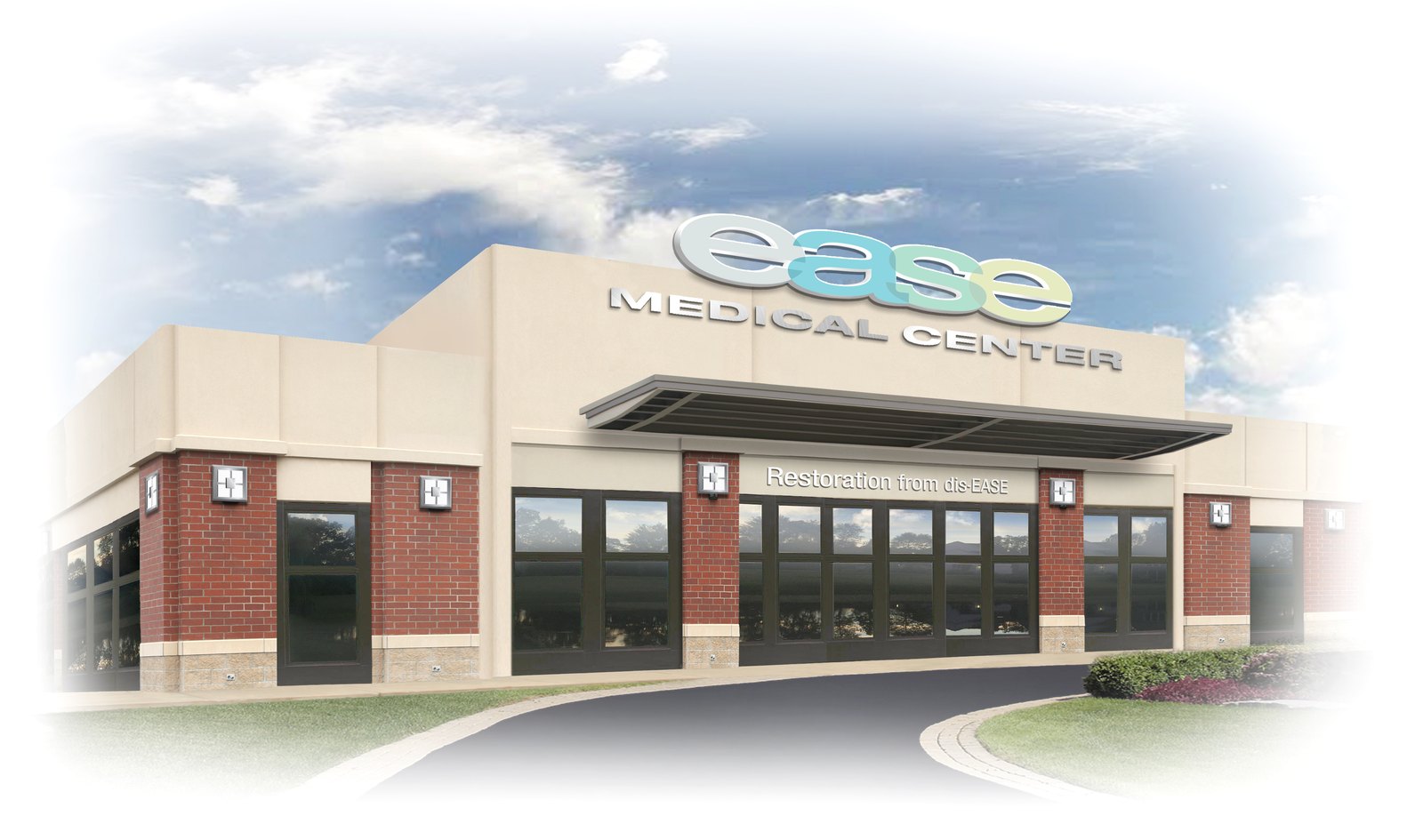
Medical Center
A world-class regenerative medical center — hyperbarics, molecular imaging, autologous stem cell transplantation, oxidative medicine, compounding pharmacy and integrative practice — built as one facility, on one campus, under one roof.
The Thesis
Ease Medical enters a rapidly changing health care ecosystem in the United States and overseas with a single conviction: people have the right to live healthy, productive lives, and health care should focus on outcomes and wellness rather than on the management of illnesses.
The opportunity is in the shift toward regenerative, preventive and primary care. Ease Medical is positioned to bring individualized, compassionate care to patients across a wide range of conditions, and to lead in progressive medical technologies and treatment protocols.
As a one-stop facility, Ease Medical lowers the cost of diagnostics and procedures by eliminating the middleman — an in-house laboratory, an in-house compounding pharmacy, and direct relationships with manufacturers, all inside the same building.
We are building this, so they may come and receive restoration.Buff Nemeth, CEO & Founder
Corporate position
A multidiscipline regenerative protocol for traumatic brain injury, PTSD and chronic degenerative disease, assembled in a single free-standing facility — with independent hyperbaric medicine, molecular imaging and an in-house laboratory treating indications inside one integrated protocol rather than across six referrals.
The Argument
Between 1904 and 1935 the number of medical schools in the United States fell by more than half, and with them went an entire ecology of training, research and practice. Whatever one concludes about whether that was worth it, the shape of what remains was decided then — and it is the reason a centre like this one has to be built from scratch rather than joined.
In 1910 the Carnegie Foundation published Abraham Flexner’s survey of 155 medical campuses. Flexner was not a physician — he held a bachelor’s degree in classics and had run a college-preparatory school — and the American Medical Association’s Council on Medical Education had approached Carnegie precisely because a third party would give the inspection credibility it could not supply itself.
The recommendation was to rebuild every school on the Johns Hopkins model: two years of college prerequisites, two preclinical laboratory years, two clinical years, university affiliation, full-time salaried faculty, an owned teaching hospital. The capital requirements alone decided which institutions survived. Rockefeller’s General Education Board then earmarked $45 million to fund the survivors, with Flexner himself joining the board in 1912 to administer it — and the money carried structural conditions: hospital affiliation, university control, faculty barred from private practice.
Of the 32 sectarian schools Flexner counted, the homeopathic and eclectic colleges were gone within a generation. On homeopathy he wrote that no specific provision need be made, because “everything of proved value in homeopathy belongs of right to scientific medicine.” On Black physicians he wrote that an “essentially untrained negro wearing an M.D. degree is dangerous.” In 2020 the Association of American Medical Colleges removed his name from its most prestigious award.
The stronger case does not rest on 1910 at all. Beginning in 1923, states enacted “basic science” licensure laws; the Federation of State Medical Boards’ own secretary wrote in JAMA in 1948 that their “evident original purpose… was to exclude chiropractors.” The AMA’s Committee on Quackery operated until 1974.
In Wilk v. American Medical Association, Judge Susan Getzendanner found in 1987 that the AMA had violated the Sherman Antitrust Act through an unlawful conspiracy to “contain and eliminate the chiropractic profession,” citing “a long history of illegal behavior.” She issued a permanent injunction. The Seventh Circuit affirmed in 1990. That is not interpretation — it is an adjudicated finding of fact about organised medicine acting to suppress a competitor.
…a long history of illegal behavior… the AMA conspired to contain and eliminate the chiropractic profession.Wilk v. AMA, 671 F. Supp. 1465 (N.D. Ill. 1987)
Where trust actually went
Americans with confidence in the medical system — tied for the lowest Gallup has recorded since 1993, and almost identical across party lines.
Americans confident in their own health care provider — statistically unchanged since 2024.
That gap is the whole opportunity, and it points somewhere specific. People have not turned against medicine or against physicians. They have turned against distance — against intermediaries, against being processed, against a system that is audited as second of ten wealthy nations on care process and last of ten on outcomes.
The demand is already moving. Complementary health approaches went from 19.2% of US adults in 2002 to 36.7% in 2022. More than half of American adults now carry two or more chronic conditions, and among 18-to-34-year-olds that figure has risen from 21.8% to 27.1% in a decade. A delivery system organised around acute episodes is meeting a population that is majority multimorbid.
Plurality already has institutions
VHA Directive 1137 (2017) requires eight complementary approaches — acupuncture, biofeedback, clinical hypnosis, guided imagery, massage, meditation, tai chi and yoga — to be available to veterans across the system. In the 2020 flagship evaluation, opioid use fell 38% among comprehensive Whole Health users against 11% among non-users; the adjusted peer-reviewed effect is a 12% dose reduction.
Since 2018, Joint Commission standard LD.04.03.13 has required hospitals to provide nonpharmacologic pain treatment — naming acupuncture, chiropractic, osteopathic manipulation, massage and physical therapy as examples.
Since 2020, CMS covers acupuncture for chronic low back pain, up to twenty sessions a year, in a decision framed explicitly as an opioid-crisis response.
The Academic Consortium for Integrative Medicine & Health counts more than eighty member institutions; Indiana University joined in 2022. Eleven Osher Centers run from UCSF and Harvard to Vanderbilt and Northwestern.
From 2017 to 2025 Indiana ran a state-funded hyperbaric oxygen and diagnostic pilot for veterans with TBI and PTSD — 43 veterans, 1,216 dives, a Purdue research component. It lapsed in April 2025 when the extension died in committee. The precedent exists; the programme does not.
Indiana does not license naturopathic doctors — bills died in 2017, 2018, 2019, 2024 and 2025 — and has no health-freedom statute. NCCIH, the NIH’s own integrative centre, has twice been proposed for elimination and twice preserved by Congress. Plurality has a foothold in American medicine. It does not yet have a guarantee, which is one more reason to build a place that documents its outcomes.
The answer to a monopoly is not fewer standards — it is standards that do not presume a single therapeutic lineage. Osteopathy is the proof: it survived 1910 not by claiming exemption from scientific medicine but by meeting it, and it now accounts for roughly one in nine American physicians and more than a quarter of medical students. Freedom in medicine means a patient can choose a different path and still be owed evidence, measurement and accountability on it. That is what this building is for.
Within these walls
Twelve departments that are ordinarily twelve separate appointments, twelve separate buildings and twelve separate bills — designed instead as one continuous patient pathway.
The Regenerative Protocol
The protocol's premise is that assessment, regeneration, oxygenation and restoration are a single continuous intervention — not four referrals. Select a stage to see the instruments and therapies that carry it.
Why Traumatic Brain Injury
Chronic Traumatic Encephalopathy is a progressive degenerative disease of the brain found in athletes and others with a history of repetitive trauma — including concussions, and the asymptomatic sub-concussive hits that never produced a diagnosis.
Repetitive trauma triggers progressive degeneration of brain tissue, including the build-up of an abnormal protein called tau. The changes can begin months, years, or decades after the last impact or the end of active play.
In an end-stage CTE brain, the overall darkness and shrinkage of the tissue indicate substantial cell death. Staining on the inside of the ventricle marks severe disease; the darkened region below it is the amygdala, the area associated with emotional control, with the disease spreading into the surrounding temporal cortex.
Clinically, the degeneration presents as memory loss, confusion, impaired judgment, impulse-control problems, aggression, depression, and eventually progressive dementia.
One caveat belongs with every CTE statistic, including the ones on this page: brain-bank series are built from donated brains, and families donate when something was wrong. Those figures describe the brains that were studied, not the share of players who will develop the disease. The honest position is that the risk is real and the magnitude is not yet established — and that a centre claiming otherwise is selling certainty it does not have.
Brain injuries arrive through motor vehicle crashes, strokes, cerebral palsy, falls, violence — even after open-heart surgery on a heart-and-lung machine. Service members returning from deployment with PTSD frequently show, on SPECT imaging, the signature of blast injury and mild concussion.
The NFL acknowledges that repetitive trauma to the head in football can cause a permanent, disabling injury to the brain.Bob Fitzsimmons — counsel to Mike Webster
‘Chronic’ means long-term, ‘traumatic’ means it's associated with trauma, ‘encephalopathy’ means a bad brain.Dr. Bennet Omalu, Medical Examiner
Mechanisms of injury
Repeated head trauma transcends every age group and every level of play — grade school, high school, college and professional.
Capabilities
Thirteen departments, each capable of standing alone as a practice — specified as they were to the physicians and funders who would build them, and corrected where the last decade moved the evidence or the law.
Emerging
The original protocol was specified in 2016. Some of it was ahead of the evidence and the evidence caught up; some of it was ahead of the evidence and the evidence went the other way. Sorting those two honestly is the only version of this document worth showing a physician.
Indications Index
Every indication named across the presentation archive, with the departments that address it. Search by condition, or filter by system.
This index is the 2016 archive as written, and it is broader than what the evidence supports today. Hyperbaric oxygen has fourteen FDA-cleared indications; the rest of its entries here are investigational or unsupported, and the same caution applies across the list. It is published in full because the corrections elsewhere on this page are only meaningful if the original claims stay visible.
The Campus
Following the opening of the medical center, Ease Medical Corporation establishes a biotechnologies facility for the manufacture of recombinant DNA human growth hormone and human insulin. Select a parcel for its program.
Ease has an expert team of practitioners on site, with collaborating physicians around the United States. That combination brings top-level progressive technologies, protocols and procedures — critical for a practice in regenerative and oxidative medicine — to the state of Indiana, and to the world.
Strategically located near
The Economics
Most of what this building offers is not covered by insurance, and pretending otherwise is how integrative centres lose patients at the front desk. These are the actual routes — what each one does, and the limit on each.
The Team
Position
The core competences Ease Medical brings into a changing market — restated for the decade that actually happened.
Foundation
…return, and be at rest and at EASE, and none shall make him afraid.
Ease Medical Corporation is a Christian faith-based corporation. Its stated goal is to establish a technologically advanced medical and research center and biotechnologies manufacturing facility, and to bring compassion and health to people around the world.