A bottle establishes existence.
The 1933 Parke-Davis artifact shows that an established pharmaceutical manufacturer supplied a cannabis preparation. One surviving bottle cannot tell us how common prescribing was. [11]
Library sub-exhibit · Hemp / Cannabis sativa
A global medical history.
From early materia medica to the pharmacy bottle: trace a plant through healing traditions, clinical curiosity, commercial medicine, and the rules that reshaped its use.

01 / Reading the record
Cannabis had a real place in several healing traditions and in nineteenth- and early twentieth-century pharmacy. Understanding that history requires keeping the type of evidence visible.
The 1933 Parke-Davis artifact shows that an established pharmaceutical manufacturer supplied a cannabis preparation. One surviving bottle cannot tell us how common prescribing was. [11]
A materia medica entry, testimony or case report documents what people described, prescribed or believed. It must be read in its language, era and institutional context. [1] [6] [9]
Traditional longevity and historical medical acceptance do not, on their own, establish clinical benefit, safety, or an appropriate present-day treatment.
Living chemistry / An aromatic constellation
Explore the small aromatic compounds that connect cannabis with citrus, forests, flowers and spice. Select a node to trace its research on mood, inflammation, pain or sleep.
8 terpene profiles · Connections show research topics, not proven benefits or effect sizes.
Aroma is a clue to chemistry. It does not predict a person's mood or a product's medical effect. Concentration, cannabinoids, route, dose and individual biology all matter.
Follow the evidence. Most profiles here describe laboratory or animal findings. Concentrated terpene oils are not instructions for ingestion, inhalation or DIY vape mixing.
02 / The long view
Filter by historical strand or search a person, place or preparation. Dates identify the surviving evidence or publication; they do not claim a single origin of cannabis medicine.
13 historical records
Archaeological evidence · Levant
Chemical residues on the smaller altar at the Judahite shrine at Tel Arad include cannabis compounds. The setting supports an interpretation of ritual burning. It does not establish a treatment, a medical dose, or a regional medical system. [4]
Archaeological evidence · Pamirs
Residues in wooden braziers from a burial ground in the eastern Pamirs provide evidence of cannabis burning in a funerary setting. This is a distinct line of evidence from a written medical prescription. [5]
Historical text · Scythian customs
Herodotus describes a Scythian practice involving hemp and heated stones. Read the passage as an ancient observer’s account of a cultural practice, with its own context and limitations. [3]
Materia medica · China
The Shennong Bencao Jing tradition is attributed to a legendary culture hero, while its compilation is much later. A Chinese medicine collection record distinguishes mafen, the young fruiting inflorescence, from hemp seed. Legendary dates such as 2700 BCE should not be treated as the date of a surviving prescription. [1]
Clinical observations · Bengal
O’Shaughnessy’s 1843 account identifies an earlier 1839 report. He drew on Indian and Persian medical knowledge, collaborators and translators, and described animal experiments and clinical cases involving pain, spasms and convulsions. These observations are an influential historical record, with the limitations of their era. [6] [7]
Official pharmacy · United States
USP’s own historical account dates cannabis inclusion to the 1850 revision. Some historical references use 1851 as the publication year. Inclusion documents an official pharmaceutical place; it does not establish how often the drug was prescribed or validate every claimed use. [13]
Medical appraisal · Britain
J. Russell Reynolds’s Lancet paper discusses therapeutic uses alongside toxic effects. The title itself captures the period’s dual concern: medical promise and the difficulty of obtaining predictable effects. [8]
Commission testimony · India
The Indian Hemp Drugs Commission assembled testimony about cultivation, preparations, consumption and perceived effects. Its conclusions distinguished moderate from excessive use. Its evidence is valuable for historical practice, while reflecting colonial institutions, selected witnesses and nineteenth-century methods. [9] [10]
Treaty · Signed 1925, in force 1928
The convention introduced international trade controls for Indian hemp and resin, while restricting cannabis extracts and tinctures to medical and scientific purposes. It was not a single blanket worldwide ban on every use of the plant. [14]
Surviving artifact · Detroit
The National Library of Medicine displays a Parke, Davis & Co. Cannabis Fluid Extract, U.S.P., dated 1933. This authentic object answers a concrete historical question: such preparations were manufactured and bottled by established pharmaceutical firms. [11]
Original statute · United States
The Marihuana Tax Act imposed occupational and transfer taxes, registration and records. It included provisions concerning medical practice. Its restrictive effects should be described through the actual law rather than the shorthand that every medical use became illegal overnight. [12]
Pharmaceutical transition · United States
USP records cannabis removal in 1942. Read this alongside changing pharmaceutical practice, formulation problems and legal constraints. No single milestone alone explains the plant’s retreat from official American medicine. [13]
No records match. Clear the search or choose “All records.”
03 / Regional histories
A global history is not a claim that every culture used the same medicine. The surviving sources differ in date, purpose, language and reliability.
The Chinese tradition includes separate descriptions of inflorescences and seeds. Hemp seed appears in a bowel-related medicinal tradition; that record cannot be treated as evidence for every claim made about psychoactive flowers.
The Shennong attribution is legendary, and precise early compilation dates remain a historical question. Li Shizhen is the author associated with Bencao Gangmu. [1] [2]
The nineteenth-century European medical story was built in dialogue with South Asian practices, not from an untouched botanical discovery. O’Shaughnessy acknowledged local medical knowledge and Persian sources in his account.
References to bhanga in early Sanskrit material require careful identification and dating. The linked nineteenth-century clinical and commission records provide firmer ground for the preparations and practices described here. [6] [7] [9]
Arad’s altar and Jirzankal’s burial braziers extend the material record of cannabis use into antiquity. Their ritual contexts should remain visible.
Herodotus provides another ancient account of hemp fumes. None of these sources alone demonstrates a medical prescription, successful treatment, or continuous therapeutic tradition. [3] [4] [5]
Clinical publications, an official pharmacopoeial place and commercial artifacts show cannabis within parts of nineteenth- and early twentieth-century medicine.
The record is geographically uneven. These sources do not support projecting the same prevalence onto Africa, the Americas before European introduction, or every European herbal tradition. Region-specific evidence is needed for region-specific claims. [8] [11] [13]
04 / Inside the apothecary
A name on a bottle tells only part of the story. Plant part, solvent, preparation, storage and the methods used to assess strength all affected the product.
| Preparation | What the record describes | What to keep distinct |
|---|---|---|
| Hemp seed remedies | Seed-based materia medica entries, including bowel-related uses in Chinese records. [1] | These are not the same material as resin-rich flowers or concentrated extracts. |
| Bhang, ganja and charas | Regional South Asian names associated with differing plant materials and preparations, documented in the commission inquiry. [9] | Local terminology, plant parts and preparation practices vary; one label does not define one uniform medicine. |
| Extracts and tinctures | Pharmaceutical preparations discussed in nineteenth-century accounts and named in later international controls. [6] [14] | Formulas evolved. Historical alcohol percentages or old apothecary units cannot safely be transferred between editions or products. |
| Commercial fluid extract | The 1933 Parke-Davis bottle provides a surviving example of a labeled U.S.P. preparation. [11] | Commercial manufacture is documented; modern cannabinoid assays and consistency cannot be assumed. |
| Burned plant material | Cannabis residues survive in specific ancient ritual settings. [4] [5] | Evidence for burning is not automatically evidence for a prescribed inhaled treatment. |
O’Shaughnessy described cases involving pain, spasms and convulsions; Reynolds later reviewed therapeutic claims alongside toxic effects. These records help explain the plant’s appeal to physicians seeking relief for difficult symptoms. [6] [7] [8]
They are historical observations, often without modern controls, standardized formulations or reliable outcome measurement. The exhibit does not translate their claims into present-day prescriptions.
05 / A changing medical system
The historical transition involves pharmaceutical practice, legal controls and public narratives. A single-cause story loses the differences between these forces.
Historical physicians confronted variability in preparations and responses. Appraisals such as Reynolds’s placed therapeutic uses beside toxic effects. Pharmacopoeial inclusion and later removal mark changing official practice. [8] [13]
The 1925 treaty regulated trade and medical preparations. The 1937 U.S. act added taxation, registration and records. Their scopes differ; neither should be flattened into a single worldwide prohibition date. [12] [14]
NLM’s exhibition places medicinal artifacts alongside later public messaging about marijuana. Studying that shift invites questions about how professional authority, stigma and regulation shape which substances are seen as medicines. [11]
Yes. A dated museum artifact establishes that Parke, Davis & Co. sold a Cannabis Fluid Extract, U.S.P., in 1933. It is stronger evidence for a specific manufactured preparation than an unattributed image circulating online. [11]
The sources support a wide range of recorded uses across several traditions, with substantial variation. They do not establish use by all cultures, consistent effectiveness across conditions, or universal acceptance among practitioners.
The original statute is a tax, registration and recordkeeping law with medical-practice provisions. Describing its restrictive consequences accurately requires reading those provisions rather than replacing the law with a slogan. [12]
This exhibit is a curated adaptation of Cannabis sativa: Global Medical History (Ancient to Early 20th Century), prepared October 23, 2026. Dates, attributions and examples were checked against linked sources. Legendary dates are separated from compilation history; ritual finds are labeled as ritual evidence; USP inclusion uses the 1850 revision; unsupported formulations and historical dosage conversions are omitted. The original research document is preserved.
06 / Source archive
Primary texts, original research and institutional collections are linked below. Some scans and journal pages may require library access. Historical testimony remains evidence of its time.
National Research Institute of Chinese Medicine, Taiwan. Collection record reproduces historical passages and distinguishes seeds from inflorescences.
National Archives of Japan. Bibliographic record for Li Shizhen’s materia medica.
Herodotus, in the Perseus Digital Library, Tufts University. An ancient account of Scythian hemp fumes.
Arie, Rosen & Namdar, 2020. Original archaeological residue analysis.
Ren et al., Science Advances, 2019. Original Jirzankal burial-site analysis.
W. B. O’Shaughnessy, Provincial Medical Journal, 1843. Original journal scan at NLM / PubMed Central.
Project Gutenberg transcription of the original account; useful for reading the acknowledgments, cases and preparation methods.
J. Russell Reynolds, The Lancet, March 22, 1890. Contemporary medical appraisal; full text may require access.
1893–94 inquiry. Original report held by Wellcome Collection; colonial administrative context matters.
National Library of Scotland digitization. The period’s own distinctions between moderate and excessive use.
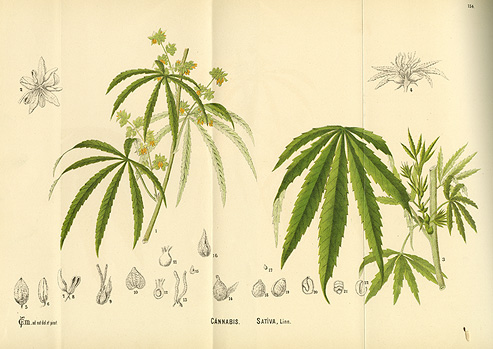
National Library of Medicine. Archival 1933 Parke-Davis bottle and 1887 Millspaugh botanical illustration.
United States Statutes at Large, volume 50, pages 551–556. Original legislation via GovInfo.
United States Pharmacopeia’s formal rescheduling submission documents the 1850 revision and 1942 removal. Institutional historical account.
United Nations Treaty Collection. Original treaty; Articles 4(f), 5 and 11 concern cannabis preparations and international trade.