Time is usually drawn as a line. Astro Chart asks what becomes visible when human history is placed within a circle. Its starting point is Earth's axial precession: the slow change in orientation that shifts the seasonal reference points against the stars. A 25,920-year circular model gives that long movement a readable form, bringing twelve equal zodiac ages, four quarter-turns, and a shared historical chronology onto one map.
Move through the instruments to follow the changing pole stars, the direction of equinox sunrise, and the relationship between Earth's orbital plane and the Milky Way. Compare those motions with climate transitions, the growth of cities, and a hundred sourced cultural records. The accompanying essays explore how celestial order becomes a language of meaning: the Silver and Golden Gates, Ezekiel's four faces, the Hindu yugas, and the Hunab Ku emblem.
At its heart is a question about recurrence and renewal: can patterns in the heavens offer a useful perspective on the changing forms of civilization and consciousness? Astronomy supplies the motion; history supplies the record; myth and philosophy offer ways of interpreting our place within the whole. Hubble and Webb's deep fields then widen the frame from Earth's great cycle to the depth of the universe—and the possibilities and responsibilities of civilizations within it.
These figures describe the chart's chosen reading scale. Equal ages are model divisions; the four yuga qualities belong to its symbolic layer. Compare calibration choices and traditional yuga durations.
Selected epoch
The Instrument
Drag the wheel. Click anything on it.
Model calibration · 25,920
Precession of the equinox · Galactic midplaneSolid marker: dated event · Open marker: approximate date
100 records · a shared chronology
The historical record
Sourced records
100 sourced records connect the printed Astrochart on pages 331–334 with further milestones in skywatching, architecture, writing, exploration and scientific discovery. Filter by subject or period, then choose a record. Open markers represent approximate dates; periods use a representative position rather than a founding date.
Epoch
2012 CE
—
Position
Milky Way band
—
Calibration
The Sky Element
What the wheel is actually measuring
Begin with the observable sky. These views follow the selected epoch: the star nearest
the north celestial pole, the solstice direction relative to the Milky Way, and the orientation of Earth's
axis. They help distinguish the motion being modeled from the meanings placed around it.
Three motions, three scales of time
Day · rotation
Earth turns on its axis, carrying an observer through daylight and darkness.
Year · orbit
Earth travels around the Sun. Its axial tilt gives the annual cycle its changing seasons.
Great cycle · precession
The axis slowly changes direction, shifting the equinoxes against the stars over roughly 26,000 years.
Carry those motions into three dimensions. Earth's orbital plane meets the galactic plane at about
60.2°. Drag to change the viewpoint, then move the year to watch the axis trace its precessional cone.
The orange and cyan directions track the December solstice and March equinox. The meter extends through
roughly one full turn and a further quarter, ending at the next modeled equinox-gate junction.
3D · drag to orbit · scroll to zoom
Past cycle — through the next quarter-turn junction—years before present
—
Structure
The four alignments
The ecliptic is the plane of Earth's orbit; the galactic plane is the main disk of the
Milky Way. Their two crossings define opposite points, called gates here. The equinoxes and solstices
define four seasonal directions, 90° apart. On this uniform model, a seasonal direction reaches a gate
every quarter turn. The cards mark four successive junctions in the model calibration; their historical
context follows below.
History & interpretation
Quarter turns and thresholds of change
The same circular scale can hold very different kinds of change: a climatic disruption, the long formation of cities, and a recent surge in knowledge. Their durations and regional effects matter as much as their proximity to a junction.
c. 10,950 BCE · climate record
A world disrupted
The Younger Dryas began about 12,900 years before 1950: an abrupt return to colder conditions across much of the Northern Hemisphere. Its approximate onset is close to this model's 10,948 BCE quarter turn. Its effects varied by region, so the comparison concerns an approximate climatic boundary.
Sumer belongs among humanity's earliest urban civilizations. Ubaid communities (c. 5500–4000 BCE) built irrigation systems and growing settlements; by c. 3200 BCE, Uruk was a major city using pictographic accounts. Urban life and writing emerged through a long development from earlier communities.
The chart's Silver Gate at 4468 BCE falls within the Ubaid period, more than a millennium before that writing milestone. The interval separates the earlier settlement landscape from the later writing milestone.
Within a century, electronics, global communication, genomics and artificial intelligence have changed what people can build and understand. The Web began at CERN in 1989; by 2025, ITU estimated that six billion people were online. Discoveries increasingly become tools for further discovery.
Progress is uneven: “exponential” describes particular measurements over particular intervals. These milestones span decades on either side of the model's 2012 anchor, giving the present a broad historical context.
A published AI method demonstrates highly accurate protein structure prediction.
Speculative interpretation
Novelty, the gates & the galactic center
Read symbolically, the Silver Gate evokes emergence into organized urban life, while the modern
Golden Gate evokes a widening capacity to connect and discover. The proposed energetic relationship
with the galactic center extends this comparison into the principle as above, so below.
It remains a hypothesis; the historical dates alone do not establish a cause.
The sky also became a setting for philosophical accounts of human existence. In
On the Cave of the Nymphs, Porphyry describes Cancer and Capricorn as gates through which
souls descend into generation and ascend from it, drawing on an earlier interpretation associated with
Numenius. This chart brings that language of passage into dialogue with the two galactic crossings.
Read Porphyry · sections 21–23 ↗
Silver
Descent & generation
Here the gate near the galactic anticenter, between Taurus and Gemini, carries the theme of entering
embodied life. Its association with civilization's emergence belongs to this exhibition's symbolic reading.
Golden
Ascent & return
The opposite gate, toward Sagittarius, carries the theme of return to a source. The image invites
reflection on integration and renewal alongside the modern transformations described above.
Cancer / Capricorn
The ancient vocabulary
Porphyry's account uses the zodiac's solstitial signs. Translating those signs into fixed
constellations or galactic coordinates adds an interpretive step: seasonal reference points drift
against the stars through precession.
Silver / Golden
The exhibition's vocabulary
These labels connect the model with later esoteric readings of celestial gates. They organize
the comparison here; they are not the names used in the cited passage from Porphyry.
Astrotheology
Reading the age off the sunrise
An astrological age is commonly associated with the stellar background of the March
equinox point. The diagram compares that direction with the equal signs used by this chart. Stars close
to the Sun are hidden by daylight, so the background is inferred from celestial positions; the last
constellation visible before dawn does not by itself identify the age.
March equinox · the eastern horizon at sunrise · schematic
—
Symbolic reading These comparisons place religious imagery
beside the chart's age sequence. The dates label the model's ages, not the origin or end of a symbol's
use. A resemblance can invite interpretation without establishing the intention of an ancient author.
At Stonehenge, the principal alignment frames midsummer sunrise and midwinter sunset. At Newgrange,
a roof-box admits the rising Sun into the chamber around the winter solstice. These monuments give
architectural form to recurring celestial events, bringing observation, place and ritual together.
English Heritage · Stonehenge ↗Heritage Ireland · Newgrange ↗
This is a tangible connection between celestial order and human culture. A solstice alignment
demonstrates attention to the annual solar cycle; interpreting a monument as a record of precession
requires additional evidence. The exhibition asks how such observations can also become symbols of
belonging within a larger cosmos.
Connections across scale
The music of the spheres
The phrase gives a name to the exhibition's central intuition: that order at one scale
may illuminate relationships at another. To explore that intuition, it helps to distinguish a shared
pattern from an interaction that can transfer energy or information.
Observed interaction
Orbital resonance provides a concrete example. For each orbit of Jupiter completed by Ganymede,
Europa completes about two and Io about four. Their repeated gravitational interactions help maintain
the relationship. Resonance depends on those interactions; a simple numerical ratio by itself is not
enough. NASA · Europa's orbital resonance ↗
Human connection
A celestial cycle can also shape human life through observation and shared practice: people mark a
season, gather at a monument, keep a calendar, and pass that knowledge onward. This offers a direct way
to think about the macrocosm and microcosm together. A pattern in the sky becomes part of collective
memory, even while its spiritual meaning remains open to interpretation.
Open hypothesis
The further proposal is that precessional phases might correspond to changes in consciousness or
civilization through an energetic relationship with the galactic center. The historical comparisons
and Hunab Ku symbolism give this question a form to contemplate. Establishing a physical connection
would require an identifiable influence and a measurable response on the relevant timescale.
How to investigate
Choose the alignment model, event definitions and date windows before looking for matches. Compare
the quarter turns with other intervals and include regional differences, dating uncertainty and events
that do not fit. Ask whether the pattern persists across independent chronologies and plausible
calibrations. That approach allows an evocative idea to become a question the historical record can
help answer.
The cosmic perspective · In'Spire, pages 28–29
A small window. An immense universe.
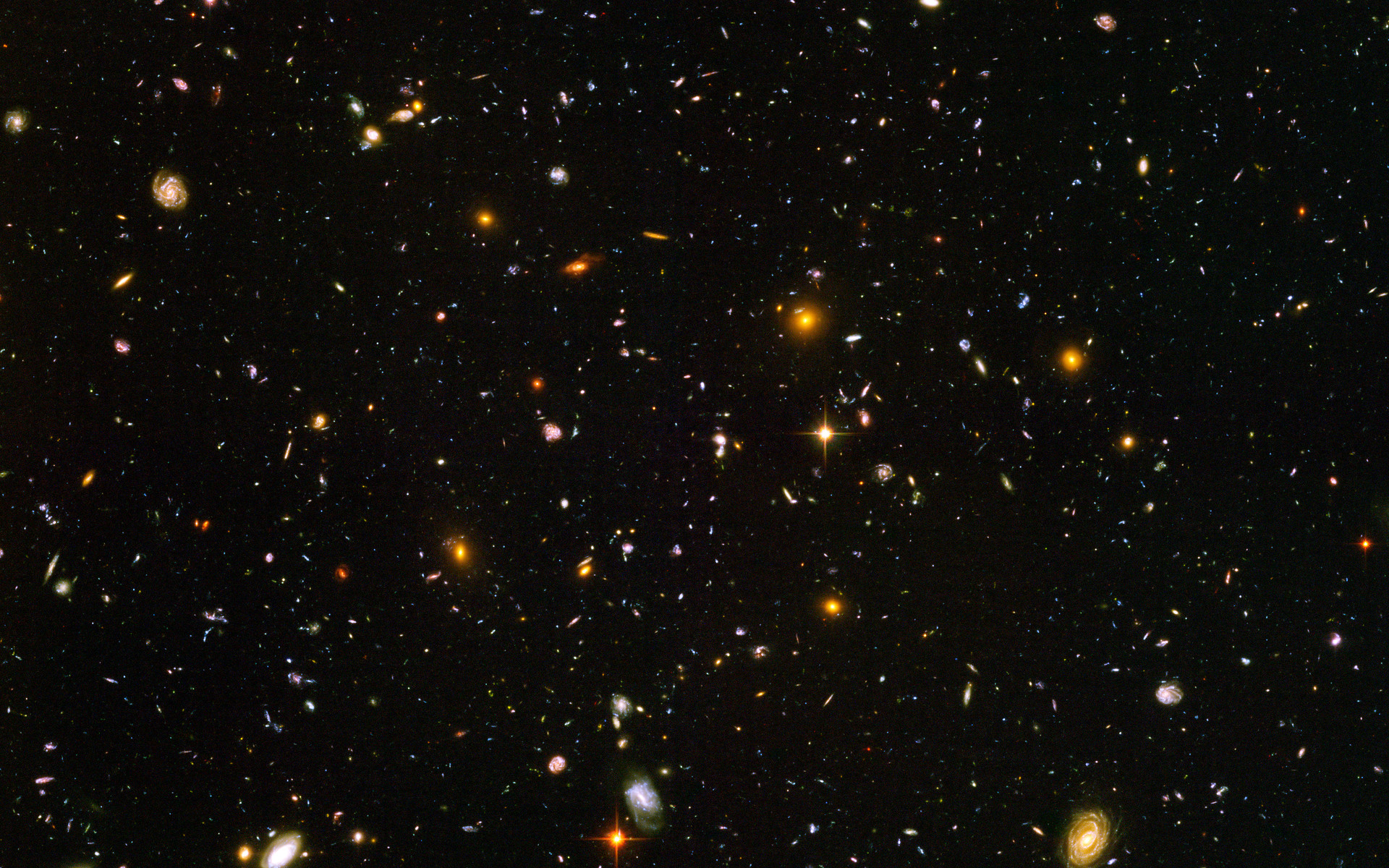
The wheel gathers human history into one circle. The deep fields widen the frame: almost every soft point and spiral below is a galaxy, containing its own vast population of stars. Hubble and James Webb turn apparently dark patches of sky into a view across cosmic time—and invite us to reconsider the scale of our place within it.
Hubble Space Telescope · Fornax · observations 2003–2004
Thousands of galaxies. One tiny patch of sky.
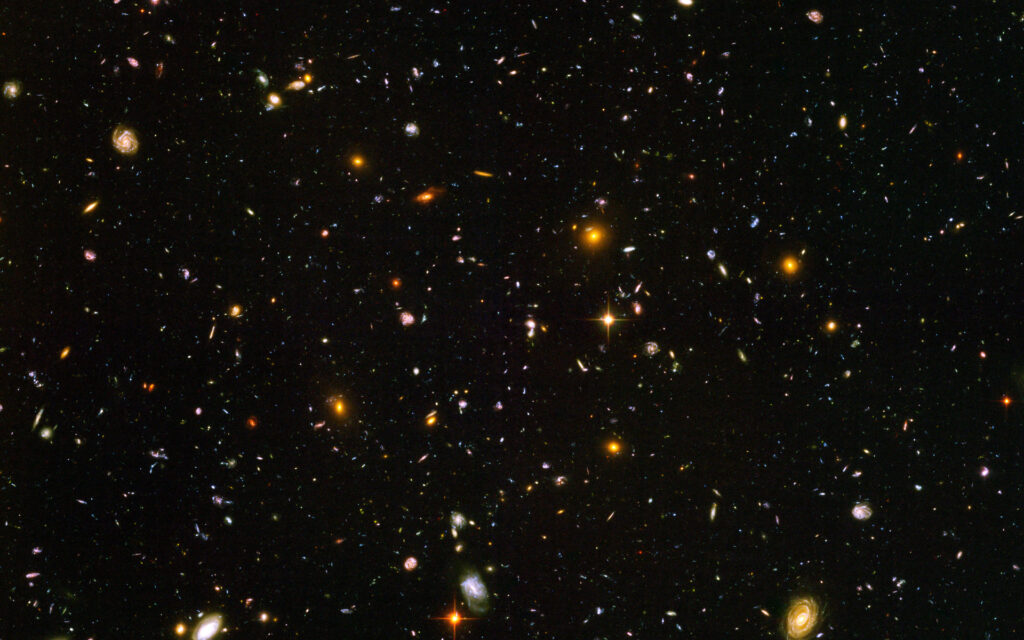
The Hubble Ultra Deep Field contains nearly 10,000 galaxies in a field about 3.1 arcminutes across. Light from objects at different distances gives this single image many depths in time. This is the Hubble image used in the In'Spire spread.
James Webb Space Telescope · SMACS 0723 · released July 2022
Gravity becomes a lens. The distant universe comes into view.
Webb's near-infrared view reveals thousands of galaxies around SMACS 0723. The cluster's mass bends and magnifies light from galaxies behind it, producing the stretched orange arcs. The telescope and a natural gravitational lens work together to reveal finer distant structure.
These are two different regions of sky. Colour combines telescope filters; Webb's infrared measurements are translated into visible colours. The galaxies are observations. Civilizations within them remain an open question.
The overview effect
Outer space. Inner perspective.
Astronauts have described a powerful reorientation when seeing Earth from space: one inhabited world, a thin atmosphere, and a shared home whose borders recede from view. Frank White named this perspective the overview effect. It can bring a sense of connection and responsibility toward the planet.
In In'Spire, Ryan describes Hubble's deep field as an invitation to turn inward as the outer frame expands. The essay places this reflection alongside samādhi and satori: contemplative images of a less divided self and a more connected life. "The only way out was in."
A universe with such immense spatial and temporal depth gives the question room to breathe. A technological society with a much longer history might develop forms of engineering, knowledge and culture far beyond our present experience.
The Kardashev scale organizes one part of that possibility by energy use. In its familiar modern form, the steps run from planetary to stellar to galactic capacity. It offers a framework for imagining capabilities and searching for possible technological signatures.
Energy use on a planetary scale could support extensive infrastructure, computation and environmental monitoring. Ecological repair, resilience and fair distribution would remain cultural and political choices requiring knowledge and coordination.
Type II · Stellar
Building around a star
Energy comparable to a star's output could sustain orbital habitats, vast observatories, materials processing and powerful computing. A hypothetical Dyson swarm uses many independently orbiting collectors. Such capacity could also support beamed propulsion and long-duration exploration.
Type III · Galactic
Many systems, a larger network
Energy use comparable to the combined output of a galaxy's stars could support engineering and archives on extraordinary scales. The result might be a network of many cultures and settlements. Light-travel delays would still shape communication, coordination and any shared history.
Capacity, culture & stewardship
More energy. A longer responsibility.
A long-lived civilization might preserve knowledge across millennia, create art in unfamiliar environments, and develop institutions for sharing resources between distant communities. It might value expansion—or choose continuity, restraint and sustainable abundance. These are cultural possibilities to contemplate; energy consumption alone measures neither wisdom nor compassion.
There are physical questions to investigate as well. Large energy systems must release waste heat, making infrared observations one way to search for possible stellar engineering. Natural sources produce infrared light too, so candidate signals require careful explanation. Signals and journeys also face the limits of light speed.
Kardashev's 1964 Type I referred to energy use comparable to Earth at that time. The familiar planetary–stellar–galactic presentation includes later extensions. The cards use that modern shorthand and describe hypothetical capabilities, without assigning humanity an inevitable timetable.
The Ledger
The chronological ledger
Browse the model's dates, historical markers and proposed correspondences. Filter the
entries or select one to open its note. The additional sourced cultural records appear in the
historical record beside the first wheel.
Honest Notes
What is measured, what is framework, what is speculation
Use these notes to check what a date, label or visual correspondence means.
Observations provide reference points; model choices organize them; interpretation proposes a relationship.
Porphyry · On the Cave of the Nymphs, sections 21–23.
Macrobius's Commentary on the Dream of Scipio and Hamlet's Mill provide further historical and interpretive context.
Sri Yukteswar, The Holy Science (1894), which gives yuga proportions of 1:2:3:4 and a Kali
floor at 500 CE. This wheel draws 1:2:4:5 with the floor at 932 CE — a divergence noted rather than
resolved.
Based on Ryan Nagy's ASTROCHART, presented as an interactive exhibition within Infinity Envisioned.
Its circular chronology connects celestial observation with historical comparison and symbolic inquiry.